







BEAM
BEAM Kurs



BEAM Kurs-Chart (BEAM)
Wechseln und vergleichen
| 1h | 24h | 7d | 14d | 30d | 1y |
|---|---|---|---|---|---|
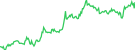
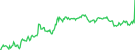
| 1.9% | 2.9% | 7.1% | 20.1% | 11.1% | 76.5% |
BEAM-Konvertierer
BEAM Statistiken
| Marktkapitalisierung | $1,822M |
|---|---|
| Marktkapitalisierung /FDV | 0.77 |
| Vollständig verwässerte Bewertung | $2,375M |
| 24-Stunden-Handelsvolumen | $59.286,06 |
| Anzahl im Umlauf | 201,544M |
| Gesamtes Angebot | 262,8M |
 Gesponsert
Gesponsert
Gesponsert
Gesponsert
Gesponsert
BEAM Historischer Kurs
| 24-Stunden-Zeitraum | $0,008815 – $0,01028 |
|---|---|
| 7-Tage-Zeitraum | $0,007504 – $0,01117 |
| Allzeithöchstwert |
$4,28 99.8%
|
| Allzeittief |
$0,004906 84.2%
|
Was denkst du heute über BEAM?

Wo kann ich BEAM kaufen?
BEAM-Token können auf Dezentralisierte Börsen und Zentralisierte Krypto-Börsen gehandelt werden. Die beliebteste Börse für den Kauf und Handel von BEAM ist Uniswap V4 (Ethereum). Das aktivste Handelspaar ist dort BEAM/ETH, mit einem Handelsvolumen von $3.153,33 in den letzten 24 Stunden. Andere beliebte Optionen sind MEXC und Uniswap V2 (Ethereum).
Wie hoch ist das tägliche Handelsvolumen von BEAM (BEAM)?
Das Handelsvolumen von BEAM (BEAM) beträgt $59.286,06 in den letzten 24 Stunden, was eine Veränderung von -6,90 % Verringerung innerhalb eines Tages darstellt und einen kürzlichen Rückgang der Marktaktivität anzeigt. Sehen Sie sich auf CoinGecko an, welche -Kryptowährungen mit dem höchsten Volumen gelistet sind.
Was ist der höchste und niedrigste Kurs für BEAM (BEAM)?
BEAM (BEAM) erreichte ein Allzeithoch von $4,28 und ein Allzeittief von $0,004906. Es wird jetzt mit -99,80 % unter diesem Kurshoch und mit 84,20 % über seinem Tiefstkurs gehandelt.
Wie hoch ist die Marktkapitalisierung von BEAM (BEAM)?
Die Marktkapitalisierung von BEAM (BEAM) beträgt $1.821.508 und steht heute auf Platz 2419 bei CoinGecko. Die Marktkapitalisierung ergibt sich aus der Multiplikation von Token-Kurs und Umlaufmenge von BEAM-Token (200 Millionen verfügbare Token werden heute am Markt gehandelt).
Wie hoch ist die vollständig verwässerte Bewertung von BEAM (BEAM)?
Die vollständig verwässerte Bewertung (Fully Diluted Valuation, FDV) von BEAM (BEAM) beträgt $2.375.131. Dies ist eine statistische Darstellung der maximalen Marktkapitalisierung unter der Annahme, dass die maximale Anzahl von 260 Millionen BEAM-Token heute im Umlauf ist. Je nachdem, wie der Zeitplan für die Ausgabe von BEAM-Token gestaltet ist, kann es mehrere Jahre dauern, bis die FDV realisiert wird.
Wie ist die Kursentwicklung von BEAM im Vergleich zu seinen Mitbewerbern?
Mit einem Erhöhung des Kurses um 7,10 % in den letzten 7 Tagen ist BEAM (BEAM) im Vergleich zum globalen Kryptowährungsmarkt, der einen nach unten von -5,80 % verzeichnete, überdurchschnittlich. Im Vergleich zu ähnlichen Kryptowährungen der Kategorie Smart-Contract-Plattform, die einen nach unten von -3,30 % verzeichneten, ist dies überdurchschnittlich.
Wie fügt man BEAM (BEAM) zu MetaMask hinzu?
Indem Sie BEAM (BEAM) zu MetaMask hinzufügen, können Sie Ihre Tokenbestände anzeigen, auf dezentralisierten Börsen handeln und mehr. Zum Hinzufügen müssen Sie BEAM als Token importieren. Sie können die Contract-Adresse von BEAM (0xe5acbb03d73267c03349c76ead672ee4d941f499) kopieren und manuell importieren, oder BEAM mit einem Klick auf CoinGecko zu MetaMask hinzufügen, wenn Sie die MetaMask-Erweiterung für Chrome installiert haben.
BEAM zu MetaMask hinzufügen.
BEAM (BEAM) Sicherheitsbewertungen

BEAM (BEAM) Token-Halterungen
BEAM-Märkte
| # | Börse | Paar | Kurs | Verbreitung | +2 % Tiefe | -2 % Tiefe | 24-Stunden-Volumen | Volumen % | Letzte Aktualisierung | |
|---|---|---|---|---|---|---|---|---|---|---|
| 1 |
DEX
|

|
$0,01000 | 0.61% | $532,91 | $531,31 | $3.153,33 | 5.27% |
vor etwa 3 Stunden
Inaktiv - Keine Trades in den letzten 3 Stunden
|
|
| 2 |
CEX
|
$0,01000 | 1.11% | $48,36 | $484,76 | $55.274,57 | 92.32% |
Kürzlich
|
||
| 3 |
DEX
|
|
$0,01000 | 0.79% | $42,21 | $42,08 | $311,28 | 0.52% |
Kürzlich
|
|
| 4 |
DEX
|
|
$0,01000 | 2.60% | $20,84 | $20,78 | $84,49 | 0.14% |
Kürzlich
|
|
| 5 |
DEX
|
|
$0,01000 | 1.01% | $20,29 | $20,23 | $30,12 | 0.05% |
vor etwa 7 Stunden
Inaktiv - Keine Trades in den letzten 3 Stunden
|
|
| 6 |
CEX
|
$0,01000 | 0.50% | $0,5676 | $0,5689 | $15,38 | 0.03% |
Kürzlich
|
||
| 7 |
DEX
|
|
$0,01000 | 0.85% | $38,65 | $38,53 | $281,50 | 0.47% |
vor etwa 5 Stunden
Inaktiv - Keine Trades in den letzten 3 Stunden
Anomalie - Handelskurs oder Volumen ist ein Ausreißer gegenüber dem Durchschnitt
|
|
| 8 |
DEX
|
|
$0,01000 | 0.74% | $57,66 | $57,49 | $210,30 | 0.35% |
vor etwa 5 Stunden
Inaktiv - Keine Trades in den letzten 3 Stunden
Anomalie - Handelskurs oder Volumen ist ein Ausreißer gegenüber dem Durchschnitt
|
|
| 9 |
DEX
|
|
$0,01000 | 0.97% | $23,06 | $22,99 | $76,68 | 0.13% |
vor etwa 7 Stunden
Inaktiv - Keine Trades in den letzten 3 Stunden
Anomalie - Handelskurs oder Volumen ist ein Ausreißer gegenüber dem Durchschnitt
|
|
| 10 |
DEX
|
|
$0,01000 | 0.98% | $20,12 | $20,06 | $37,51 | 0.06% |
vor etwa 6 Stunden
Inaktiv - Keine Trades in den letzten 3 Stunden
Anomalie - Handelskurs oder Volumen ist ein Ausreißer gegenüber dem Durchschnitt
|
|


Globale BEAM-Kurse
Ähnliche Coins, die Sie interessieren könnten















 GeckoAI



 Oder schauen Sie sich die App in den App Stores an


