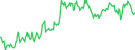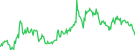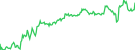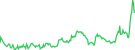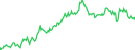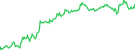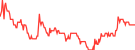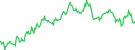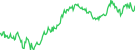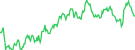




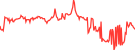
IOTA Rally Stalled Above $0.060, Dropped Towards $0.052
1 source







| 1h | 24h | 7j | 14j | 30j | 1a |
|---|---|---|---|---|---|
| 0.3% | 1.0% | 7.0% | 12.4% | 16.5% | 72.2% |
| Capitalisation boursière | $197,188M |
|---|---|
| Capitalisation boursière / FDV | 0.94 |
| Évaluation après dilution | $210,152M |
| Volume de négociation sur 24 h | $4,263M |
| Position ouverte Perps 24 h | $16,778M |
| OI / Capitalisation boursière | 8,51% |
| Taux de financement Perps 8 h | -0,0065% |
| Vol. 24 h Perps / au comptant | 3,2× |
| Offre en circulation | 4,704B |
| Offre totale | 5,013B |
| Offre maximale | ∞ |
Sponsorisé
Sponsorisé
Sponsorisé
| Fourchette 24h | $0,04183 – $0,04314 |
|---|---|
| Fourchette 7j | $0,04183 – $0,04868 |
| Niveau record |
$5,25 99.2%
|
| Plus bas niveau historique |
$0,03113 34.7%
|

Les jetons IOTA peuvent être échangés sur des plateformes d’échange centralisées. L'échange le plus populaire pour acheter et échanger IOTA est OKX, où la paire la plus active IOTA/USDT a un volume d'échange de $265 506,19 au cours des dernières 24 heures. D'autres options populaires incluent Gate et Binance.
Le volume d'échange de IOTA (IOTA) est de $4 262 881,53 au cours des dernières 24 heures, ce qui représente une différence de 22,50 % hausse par rapport à hier et signale une activité hausse récente sur le marché. Consultez la liste des cryptomonnaies à fort volume sur CoinGecko.
IOTA (IOTA) a atteint un niveau le plus élevé de $5,25 et le niveau le plus bas de $0,03113. Il se négocie actuellement -99,20 % en dessous de ce sommet et 34,70 % au-dessus de son cours le plus bas.
La capitalisation boursière de IOTA (IOTA) est $197 187 819 et est classée 179 sur CoinGecko aujourd'hui. La capitalisation boursière est mesurée en multipliant le cours du jeton par l'offre en circulation de jetons IOTA (4,7 milliard jetons sont échangeables sur le marché aujourd'hui).
La valorisation entièrement diluée (FDV) de IOTA (IOTA) est $210 151 588. Il s'agit d'une représentation statistique de la capitalisation boursière maximale, en supposant que le nombre total de 5 milliard jetons ETH est en circulation aujourd'hui.
Avec un changement déclin de -7,00 % pendant les 7 derniers jours, IOTA (IOTA) représente sous-performance une part du marché de crypto monnaie global de bas -2,20 %, par rapport à sous-performance de catégorie similare Plateforme de contrats intelligents qui représente bas -2,60 %.



| # | Plate-forme d'échange | Paire | Cours | Spread | +2 % de profondeur | -2 % de profondeur | Volume sur 24 h | Volume en % | Dernière mise à jour | |
|---|---|---|---|---|---|---|---|---|---|---|
| 1 |
CEX
|
$0,04000 | 0.10% | $80 805,21 | $88 515,02 | $247 294 | 5.31% |
Récemment
|
||
| 2 |
CEX
|
$0,04000 | 0.24% | $50 578,87 | $55 602,89 | $482 686 | 10.36% |
Récemment
|
||
| 3 |
CEX
|
$0,04000 | 0.12% | $49 728,03 | $46 888,32 | $106 525 | 2.29% |
Récemment
|
||
| 4 |
CEX
|
$0,04000 | 0.17% | $50 690,46 | $57 362,68 | $89 687,95 | 1.92% |
Récemment
|
||
| 5 |
CEX
|
$0,04000 | 0.24% | $49 341,56 | $27 849,10 | $47 706,04 | 1.02% |
Récemment
|
||
| 6 |
CEX
|
$0,04000 | 0.18% | $17 432,27 | $40 491,09 | $33 046,56 | 0.71% |
Récemment
|
||
| 7 |
CEX
|
$0,04000 | 0.24% | $50 570,55 | $55 640,71 | $79 977,39 | 1.72% |
Récemment
|
||
| 8 |
CEX
|
$0,04000 | 0.24% | $59 187,61 | $65 177,33 | $179 242 | 3.85% |
Récemment
|
||
| 9 |
CEX
|
$0,04000 | 0.71% | $47 042,11 | $60 606,49 | $404 297 | 8.67% |
Récemment
|
||
| 10 |
CEX
|
$0,04000 | 0.50% | $39 919,22 | $39 602,93 | $60 265,27 | 1.29% |
Récemment
|
||
| # | Plate-forme d'échange | Paire | Cours | Spread | Position ouverte | Taux de financement | Volume sur 24 h | Volume en % | Dernière mise à jour | |
|---|---|---|---|---|---|---|---|---|---|---|
| 1 |
CEX
|
$0,04178 | 0.02% | 2 649 701 $ |
-0,020%
Positions courtes paient les positions longues
|
$2 194 909 | 51.49% |
Récemment
|
||
| 2 |
CEX
|
$0,04191 | 0.02% | 825 574 $ |
0,010%
Positions longues paient les positions courtes
|
$2 308 810 | 54.16% |
Récemment
|
||
| 3 |
CEX
|
$0,04174 | 0.05% | 2 068 147 $ |
-0,008%
Positions courtes paient les positions longues
|
$677 566 | 15.89% |
Récemment
|
||
| 4 |
CEX
|
$0,04180 | 0.02% | 838 377 $ |
-0,019%
Positions courtes paient les positions longues
|
$1 389 223 | 32.59% |
Récemment
|
||
| 5 |
CEX
|
$0,04195 | 0.05% | 1 015 759 $ |
-0,020%
Positions courtes paient les positions longues
|
$838 688 | 19.67% |
Récemment
|
||
| 6 |
DEX
|
$0,04183 | 0.04% | 1 217 298 $ |
0,001%
Positions longues paient les positions courtes
|
$72 604,50 | 1.7% |
Récemment
|
||
| 7 |
CEX
|
$0,04189 | 0.05% | 557 587 $ |
0,000%
Positions longues paient les positions courtes
|
$361 191 | 8.47% |
Récemment
|
||
| 8 |
CEX
|
$0,04177 | 0.07% | 499 633 $ |
-0,022%
Positions courtes paient les positions longues
|
$428 206 | 10.04% |
Récemment
|
||
| 9 |
CEX
|
$0,04180 | 0.1% | 1 566 909 $ |
0,010%
Positions longues paient les positions courtes
|
$57 582,65 | 1.35% |
Récemment
|
||
| 10 |
CEX
|
$0,04194 | 0.02% | 368 017 $ |
-0,020%
Positions courtes paient les positions longues
|
$170 173 | 3.99% |
Récemment
|
||





 GeckoAI


 Ou consultez l'application dans les magasins d'applications