



Karat
KAT Price
How is the price of Karat (KAT) calculated?
The price of Karat (KAT) is calculated in real-time by aggregating the latest data across 1 exchanges and 1 markets, using a global volume-weighted average formula. Learn more about how crypto prices are calculated on CoinGecko.


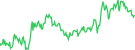
Karat Price Chart (KAT)
Switch & Compare
| 1h | 24h | 7d | 14d | 30d | 1y |
|---|---|---|---|---|---|
| 0.0% | 0.0% | 0.1% | 0.2% | 1.8% | 8.5% |
KAT Converter
Karat Statistics
|
Market Cap
Market Cap = Current Price x Circulating Supply
Refers to the total market value of a cryptocurrency’s circulating supply. It is similar to the stock market’s measurement of multiplying price per share by shares readily available in the market (not held & locked by insiders, governments) Read More |
$728,379 |
|---|---|
|
Market Cap / FDV
The proportion of current market capitalization compares to market capitalization when meeting max supply.
The closer the Mkt Cap/FDV to 1, the closer the current market capitalization to its fully diluted valuation and vice versa. Learn more about Mkt Cap/FDV here. |
0.56 |
|
Fully Diluted Valuation
Fully Diluted Valuation (FDV) = Current Price x Total Supply
Fully Diluted Valuation (FDV) is the theoretical market capitalization of a coin if the entirety of its supply is in circulation, based on its current market price. The FDV value is theoretical as increasing the circulating supply of a coin may impact its market price. Also depending on the tokenomics, emission schedule or lock-up period of a coin's supply, it may take a significant time before its entire supply is released into circulation. Learn more about FDV here. |
$1,308,908 |
|
24 Hour Trading Vol
A measure of a cryptocurrency trading volume across all tracked platforms in the last 24 hours. This is tracked on a rolling 24-hour basis with no open/closing times.
Read More |
$1,332.44 |
|
Circulating Supply
The amount of coins that are circulating in the market and are tradeable by the public. It is comparable to looking at shares readily available in the market (not held & locked by insiders, governments).
Read More |
1,090,715,670 |
|
Total Supply
The amount of coins that have already been created, minus any coins that have been burned (removed from circulation). It is comparable to outstanding shares in the stock market.
Total Supply = Onchain supply - burned tokens |
1,960,031,820 |
|
Max Supply
The maximum number of coins coded to exist in the lifetime of the cryptocurrency. It is comparable to the maximum number of issuable shares in the stock market.
Max Supply = Theoretical maximum as coded |
2,000,000,000 |
 Sponsored
Sponsored
Sponsored
Sponsored
Sponsored
KAT Historical Price
| 24h Range | $0.0006660 – $0.0006963 |
|---|---|
| 7d Range | $0.0006658 – $0.0006969 |
| All-Time High |
$0.01685 96.0%
Feb 18, 2024 (over 2 years)
|
| All-Time Low |
$0.0003111 114.6%
Mar 05, 2026 (4 months)
|
How do you feel about KAT today?
What is Karat about?
Karat utilizes on-chain MPC and ZK technologies to create a sharable Web 2 & 3 ID data layer. It encrypts user data such as email and Twitter, links it to the user’s wallet, and stores it on IPFS. Users and nodes are provided with the MPC private key, enabling decentralized control over data access permissions. This infrastructure aims to serve as the foundation for future Dapps requiring Web3 social, data indexing, advertising delivery, and login permissions.
What makes Karat unique?
1. Karat is the largest and most active protocol on Zksync, with over 250,000 KYC wallets, each verified with Web3 wallet and Web2 data. Over 100 protocols have requested to stake and pay for this data during the alpha phase.
2. Karat's genesis validators include major projects like KCC, OKX, Bitmart, and NEO, along with a network of 300 top-tier KOL validators managing 250,000 users.
3. Karat's MPC data infrastructure allows users to grant varying levels of access to Dapps, enabling zero-knowledge proofs of Web2 behavior credentials without revealing identity. Users can log into multiple platforms with one ID while maintaining ZK proof of credentials across Web2 and Web3.
What's the history of Karat?
Karat hosted an IDO on its official website from July 19 to August 19, with two rounds:
- First round: July 19-21, sale price $0.03, raising $200,000.
- Second round: July 22-August 19, sale price $0.035, raising $317,092.
What's next for Karat?
- Q3 2023: Utilize MPC to build a bridge between Web2 and Web3 data, creating a unified ecosystem for true data ownership.
- Q4 2023: Develop a Karat-specific EIP standard for digital identity and verifiable credentials, enhancing EVM network interoperability.
- Q1 2024: Revolutionize online authorization with W3Auth, mirroring oAuth's role in Web2, using MPC for user control and interoperability.
- Q2 2024: Partner with identity providers like Lens and Worldcoin, integrating them into Karat's ecosystem and developing a scoring system for applications.
- Q2 2024: Integrate Account Abstraction (EIP4337) to enhance user experience by eliminating gas and blockchain friction.
- Q3 2024: Incorporate zero-knowledge technology to protect user privacy and bolster data ownership.
What can Karat be used for?
Allocations:
- 70% for 10-year Karat mining, stored in a multisig wallet managed by zkSync Official, NEO, Bitmart, and Karat Founders.
- 10.5% for the team, 10% for operations, 7.5% for investors, and 2% for advisors, all with a 48-month linear release after the first 3 months.
Users must stake 500 KAT for 7 days to join private chat rooms and mint a Karat ID. Content creators receive 50 KAT for each new user, with rewards based on user growth. A 10% withdrawal fee applies.
Karat ID: An omnichain name service connecting Web3 addresses and Web2 identities, requiring a small KAT stake. Over 350,000 users have created Karat IDs.
Verifiable Credentials: Users can mint Web2 data on-chain for Dapps to query and build protocols around.
Validator Staking: Requires staking over 350,000 KAT to start a validator.
Growth Staking: Users stake under high-growth validators to share rewards when new users join, with a portion of fees burned.
Data Request: Dapps pay KAT to access user data for indexing, marketing, etc., with a portion of fees burned.
Where can you buy Karat?
KAT tokens can be traded on centralized crypto exchanges. The most popular exchange to buy and trade Karat is Gate, where the most active trading pair KAT/USDT has a trading volume of $1,336.40 in the last 24 hours.
What is the daily trading volume of Karat (KAT)?
The trading volume of Karat (KAT) is $1,336.40 in the last 24 hours, representing a 11.20% increase from one day ago and signalling a recent rise in market activity. Check out CoinGecko’s list of highest volume cryptocurrencies.
What is the highest and lowest price for Karat (KAT)?
Karat (KAT) reached an all-time high of $0.01685 and an all-time low of $0.0003111. It’s now trading -96.00% below that peak and 114.60% above its lowest price.
What is the market cap of Karat (KAT)?
Market capitalization of Karat (KAT) is $728,362 and is ranked #3191 on CoinGecko today. Market cap is measured by multiplying token price with the circulating supply of KAT tokens (1.1 Billion tokens are tradable on the market today).
What is the fully diluted valuation of Karat (KAT)?
The fully diluted valuation (FDV) of Karat (KAT) is $1,308,878. This is a statistical representation of the maximum market cap, assuming the maximum number of 2 Billion KAT tokens are in circulation today. Depending on how the emission schedule of KAT tokens are designed, it might take multiple years before FDV is realized.
How does the price performance of Karat compare against its peers?
With a price increase of 0.10% in the last 7 days, Karat (KAT) is outperforming the global cryptocurrency market which is down -2.80%, while outperforming when compared to similar ZkSync Ecosystem cryptocurrencies which are up 0.00%.
Karat Markets

You may be interested in these latest crypto news



You may be interested in these crypto articles

Global Karat Prices
Related Coins You May Like













 GeckoAI














 Or check it out in the app stores