





 Make us preferred on Google
CoinGecko API is the most widely used crypto market data API in the industry, trusted by platforms like MetaMask, Coinbase, and Etherscan. It tracks over 48 million+ crypto assets across 360+ blockchain networks, and for the vast majority of crypto applications, it delivers the broadest token coverage, a complete AI-native data stack, the most transparent pricing, and one of the most developer-friendly experiences available.
But no single API is the right fit for every use case. Some developers need raw tick-level CEX data with nanosecond precision for high-frequency trading. Others need direct access to mempool transactions and unconfirmed blockchain data for MEV strategies. And some institutional teams require deeper onchain intelligence that synthesizes raw data into entity-level behavioral signals, going beyond what a general-purpose market data aggregator is designed to provide.
We built CoinGecko's API, so we know exactly where it excels and where developers might be better served elsewhere. In this guide, we compare seven alternatives against CoinGecko API across pricing, data depth, data latency, and developer experience so you can find the right fit for what you are building.

How We Evaluated These API Alternatives
We evaluated each alternative across nine dimensions that reflect what developers actually care about when choosing a crypto data API: data coverage, endpoint breadth, free tier details, paid tier entry price, data latency and delivery methods, CEX data, onchain and DEX data, and developer experience, while also acknowledging their strengths and limitations.
Quick Comparison of CoinGecko API Alternatives
| API Provider | Free Tier | Pricing | Assets (Coins & Tokens) | Chains | CEX Data | DEX Data | Data Delivery Methods | Best For |
|---|---|---|---|---|---|---|---|---|
| CoinGecko | 10k calls/mo | From $29/mo | 48M+ | 360+ | Yes | Yes | REST API, WebSocket, Webhook | Wallets, swaps, exchanges, and products that require broad and comprehensive market data |
| CoinMarketCap | 10k credits/mo | From $29/mo | 2.4M+ | 120+ | Yes | Yes | REST API only | Basic market rankings and price feeds for personal projects |
| CoinDesk | None | Contact Sales | 7k+ | 10+ | Yes | Yes | REST API, WebSocket | Institutional-grade tick-level CEX data |
| CoinAPI | $25 signup credit | From $79/mo | 19k+ | 50+ | Yes | Yes | REST API, WebSocket | Advanced quantitative analysis and backtesting for CEX pairs |
| CoinPaprika | 20k calls/mo | From $99/mo | 510k+ | 30+ | Yes | Yes | REST API, WebSocket | Fetching detailed developer and founder metadata |
| DexScreener | Rate limited | None | 2M+ | 80+ | No | Yes | REST API only | Memecoins and tracking of advertised tokens on DexScreener |
| Bitquery | 1k points trial | Contact Sales | 1M+ | 40+ | No | Yes | REST API, WebSocket | Onchain GraphQL streaming and mempool data |
| Glassnode | None | Contact Sales | 1.7k+ | 10+ | Yes | Yes | REST API only | Entity-adjusted macro indicators and institutional research |
CoinGecko API Overview
1. CoinGecko API

CoinGecko is often referred to as the "gold standard" for crypto market data. The API covers 1,900+ exchanges (both CEX and DEX) utilizing a proprietary aggregation methodology that produces highly trusted, independently verifiable data. This reliability has made it the provider of choice for major platforms like MetaMask, Coinbase, and Etherscan, and Deblock to achieve the MiCA compliance required to operate as Europe’s first onchain bank. Beyond price and market cap, it covers futures, derivatives, public treasuries, NFT floor prices, onchain DEX data, and real-time crypto news from 100+ sources.
For production-grade applications, CoinGecko API provides a complete data delivery stack with REST APIs, sub-second WebSocket streaming, and Webhook notifications, alongside a commercial license starting from the Basic plan at just $29/month, making it one of the most cost-effective commercial crypto data solutions. It also supports crypto and stablecoin payments across 6 major networks and 90+ assets on selected plans, making API more accessible to crypto-native users.
CoinGecko API Strengths
-
Covers 1,900+ exchanges (CEX and DEX), 360+ networks, and 48M+ tokens with historical data going back to 2013.
-
Flat credit model where batched endpoint requests, pagination, and multi-currency conversions never cost extra.
-
Generous free tier that includes 50+ endpoints, 10,000 monthly credits, and 1 year of historical data.
-
Real-time data delivery (cacheless REST endpoints) from Basic and Analyst plan onwards, with sub-second WebSocket streaming and Webhook push notifications for event-driven coin metadata sync.
-
Broad historical market data, with CEX historical data from 2013 and onchain OHLCV granularity down to 1-second intervals.
-
Unique data endpoints, such as the onchain Pools Megafilter endpoint, provide advanced filtering across DEX pools using criteria like honeypot detection. The API also enables sector-level market data queries using over 700+ categories and delivers real-time crypto news from 100+ publishers via the News endpoint, alongside AI-powered Coin Insights for curated, coin-level market context.
-
Data is highly accessible through a REST API, WebSocket API, Webhook notifications, the Model Context Protocol (MCP), a Command Line Interface (CLI), and a user-friendly, no-code Google Sheets and Microsoft Excel Add-on.
CoinGecko API Weaknesses
CoinGecko aggregates and normalizes CEX data across 1,900+ exchanges rather than providing raw tick-level feeds from individual ones. Because it is an aggregator rather than a per-exchange data source, it does not offer multi-exchange order book replay or tick-level historical reconstruction. Developers building latency arbitrage systems that require sub-second order book updates across individual centralized exchanges will need exchange-native APIs.
That said, CoinGecko API's data latency scales with its paid plans. On the Demo and Basic plan, REST endpoints are generally cached at 60-second and 10-second intervals respectively, with selected endpoints offering cacheless data even on the Basic plan. From the Analyst plan ($129/month) onwards, all endpoints offer cacheless, real-time data returned directly from CoinGecko's servers.
On the DEX side, CoinGecko API delivers onchain trade data via WebSocket at sub-second intervals (as fast as 0.1s for actively traded pools) and OHLCV at 1-second intervals, without requiring developers to run their own nodes or parse raw transaction logs. Where a raw blockchain data provider like Bitquery gives you full flexibility through custom GraphQL queries, CoinGecko API abstracts that complexity and provides low-latency DEX data ready to use out of the box.
So while CoinGecko API is not built for high-frequency CEX tick trading, it still offers the convenience of pulling current exchange ticker pair prices, orderbook depth, and spread data across 1,900+ exchanges from a single API. These data are delivered in real-time via cacheless endpoints and sub-second WebSocket streaming, making it perfect for the vast majority of production-grade use cases.
CoinGecko API Pricing
-
Free Plan: 10,000 credits/month, 50+ endpoints, 1 year historical data.
-
Lowest Paid Tier: Basic plan starting at $29/month, 100,000 credits/month, 50+ endpoints, and 2 years of historical data, WebSocket streaming, and Webhook, and commercial license included.
-
Highest Paid Tier: Pro+ 15M plan, starting at $2,997/month.
-
Enterprise: Custom pricing with 99.9% uptime SLA, SOC 2 Type 2 certification, dedicated Customer Success Manager, 24/7 Slack support, and custom licensing for data redistribution.
Who CoinGecko API Is Best For
Production-grade and Enterprise teams building web3 and crypto wallets, portfolio trackers, crypto screeners, analytics dashboards, cross-chain swaps, crypto exchanges, and any application that needs the broadest possible coverage across both centralized and decentralized markets.
The Best CoinGecko API Alternatives
2. CoinMarketCap API

CoinMarketCap is one of the most recognized names in crypto data and remains a familiar option for developers already embedded in its ecosystem. It tracks 2.4 million+ DEX tokens and 10,000+ CEX coins across 790+ exchanges and 120+ blockchain networks. It also offers its own DEX data product called DexScan, with 350+ DEXs tracked and 20 dedicated DEX endpoints covering token data, K-line charts, liquidity pools, swap history, and Go+ security scans.
CoinMarketCap API Strengths
-
Well-established brand with wide industry recognition.
-
55 API endpoints covering cryptocurrency rankings, exchange data, global metrics, community trending data, content/news feeds, and DEX data via DexScan.
-
Historical CEX data going back to 2013, with DEX data from 2020.
-
DexScan includes dedicated meme coin filtering endpoints with lifecycle stages such as “new creations”, “about to graduate”, and “graduates”.
CoinMarketCap API Weaknesses
The free tier includes 15,000 monthly credits at 50 requests per minute, with 1 year of daily and 1 month of intraday historical data on its crypto endpoints. The credit system charges extra for pagination past 100 results, requesting prices in more than one fiat currency, and requesting multiple coins in a single call (each coin in the request is charged individually, unlike true batch endpoints where the entire multi-coin request counts as one call). Because of that, a single API call can cost anywhere from 1 to 100+ credits depending on the parameters you pass.
Daily history is limited to 1 year on the free plan and 3 years on the $29/month Builder plan, with full history from 2010 starting at the $79/month Startup plan. The Professional plan is $699/month. CoinMarketCap does not offer WebSocket streaming on its self-serve plans.
There is also one billing behavior that catches developers off guard. CoinMarketCap charges a credit on every API call, even when you're retrieving the same old cached data within the cache period. For applications that poll frequently, this means your monthly credit quota drains much faster than expected. Unlike CoinMarketCap, CoinGecko API doesn't charge a credit when you're retrieving the same data again within the cache period, so polling before the cache refreshes does not consume a credit.
CoinMarketCap API Pricing
-
Free Plan: 15,000 credits/month, 50 requests/min, 1 year of daily history.
-
Lowest Paid Tier: Builder at $29/month, 150,000 credits/month, 300 requests/min, 3 years of daily history.
-
Highest Paid Tier: Professional at $699/month, 5000K credits/month.
-
Enterprise: Custom pricing with 30M credits and 99.9% SLA.
Who CoinMarketCap API Is Best For
Developers working on personal projects who are already familiar with the CoinMarketCap ecosystem and need basic market rankings and price data without requiring extensive historical access or real-time streaming.
3. CoinDesk API

Formerly known as CryptoCompare or CCData, the CoinDesk API focuses heavily on tick-level CEX data for quantitative trading. For teams that specifically need nanosecond-precision timestamps, Level 2 order book snapshots, or gapless trade reconstruction via proprietary CCSEQ sequence tags, CoinDesk provides capabilities suited for individual exchange-level tick data and algo replay. The API offers 200+ endpoints across REST and 10+ WebSocket channels, covering spot, futures, options, and social sentiment data across 7,000+ assets and 300+ exchanges.
CoinDesk API Strengths
-
Over 10 years of historical data with tick-level granularity and nanosecond precision.
-
200+ endpoints spanning spot, futures, options, onchain and DEX swaps.
-
Standardized instrument mapping that resolves ticker symbol conflicts across exchanges.
-
FCA-regulated and EU BMR-compliant benchmarks for institutional portfolio valuation.
CoinDesk API Weaknesses
CoinDesk has discontinued its free API tier and every paid plan requires contacting their sales team. There is no transparent pricing listed, which makes it difficult for startups and independent developers to forecast costs or self-serve into a paid tier.
CoinDesk API Pricing
-
Lowest Paid Tier: Start-Up Plan, contact sales for pricing.
-
Highest Paid Tier: Enterprise, contact sales for pricing.
-
Enterprise: Full dataset access, 10+ years of history, custom cloud delivery, 24/7 support.
Who CoinDesk API Is Best For
Quantitative trading firms that specifically need tick-level CEX data, order book replay, and regulatory-grade benchmarks for compliance workflows.
4. CoinAPI

CoinAPI is built for developers who come from traditional finance and expect institutional-grade data infrastructure. Its Market Data API provides 14+ years of backfilled tick-level historical data across 19,000+ assets, 400+ exchanges, and 50+ blockchain networks. For developers who need tick-level CEX granularity going back over a decade for algorithm backtesting, CoinAPI delivers on that specific requirement. CoinAPI also offers separate products beyond market data, including an Execution Management System (EMS) for trade routing and an Indexes API for custom benchmarks, though each of these are charged separately.
CoinAPI Strengths
-
14+ years of backfilled historical data covering trades, quotes, and Level 2/Level 3 order books.
-
Exchange Rates WebSocket streaming available on paid plans.
-
Official SDKs in 8 languages (C#, C++, Go, Java, JavaScript, Python, R, Ruby) and FIX API support.
-
Additional API products for order execution (EMS) and custom indexes (charged separately from the Market Data API).
CoinAPI Weaknesses
CoinAPI’s pricing model is one of the most complex in the space. The Market Data REST API charges per 100 data points returned (not per call), the Exchange Rates API bills per individual "rate" in the response, and their Flat Files S3 endpoint charges $250 per 1,000 OHLCV download requests. The free tier is a one-time $25 signup credit (credit card required) with no recurring monthly allocation and no uptime SLA guarantee. Each API product (Market Data, EMS, Exchange Rates, Indexes) also carries its own subscription, so costs can add up quickly if you need more than one of their products.
CoinAPI Pricing
-
Free Plan: One-time $25 signup credit (requires adding a payment method first).
-
Lowest Paid Tier: Startup Market Data, starting at $79/month.
-
Highest Paid Tier: Pro, starting at $599/month.
-
Enterprise: Custom high-volume packages with 99.9% SLA.
Who CoinAPI Is Best For
Traders performing multi-year algorithm backtesting for CEX pairs, quantitative analysis, and teams with TradFi backgrounds who need deep historical data and FIX protocol integration.
5. CoinPaprika API
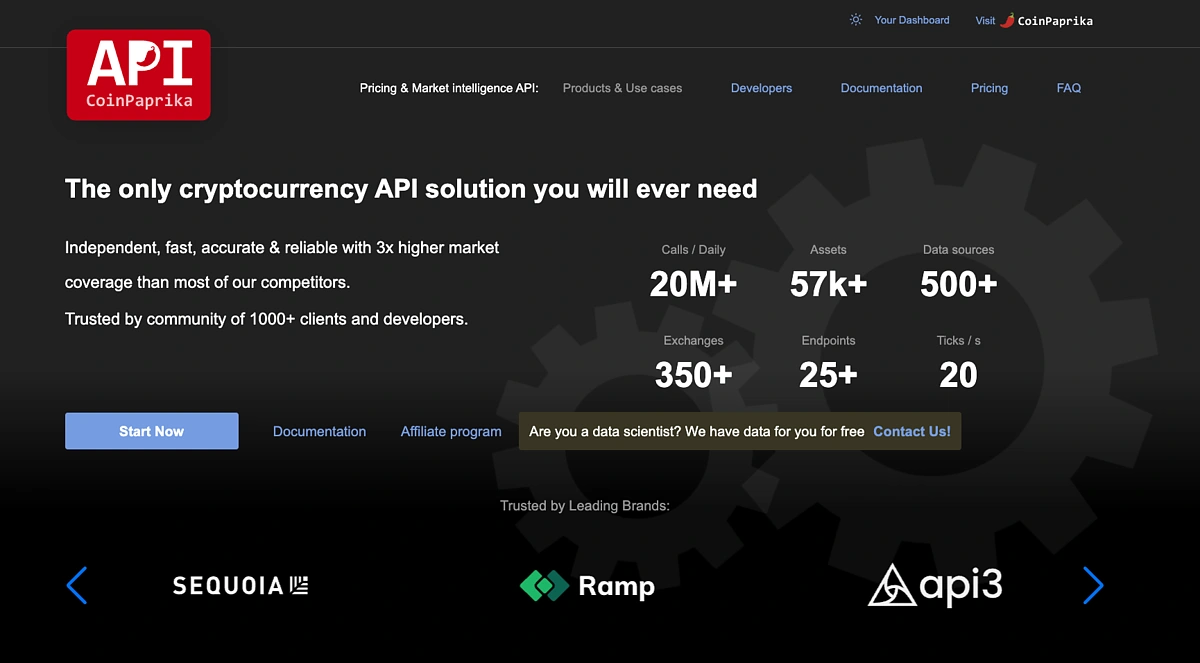
CoinPaprika covers both centralized and decentralized exchanges through two separate services: CoinPaprika API for CEX data (10,000+ coins, 350+ exchanges) and DexPaprika API for DEX data. Like CoinGecko API, it follows a one call equals one credit billing model with no multipliers for pagination or currency conversions. CoinPaprika stands out with its unique "People" endpoint, which lets developers look up biographical information, social media profiles, and team positions for crypto project founders. It is the only API in this comparison that offers this kind of team-level metadata.
CoinPaprika API Strengths
-
Unique "People" endpoints for looking up project founders, their social profiles, and team roles.
-
Free tier offering 20,000 monthly calls and 1 year of daily historical data.
-
Official SDKs in 7 languages including Rust, Kotlin, Swift, Go, and Python.
-
DexPaprika provides a free SSE streaming API for real-time onchain token prices with no API key needed for its showcase assets.
CoinPaprika API Weaknesses
CoinPaprika API and DexPaprika API are billed entirely separately, so upgrading a CoinPaprika plan does not unlock DexPaprika’s paid plans, which are priced separately from $30/month. Developers who need both CEX and DEX coverage end up managing two integrations and two billing relationships, whereas CoinGecko API delivers both through a single integration. WebSocket streaming on CoinPaprika is restricted to custom Enterprise plans only. The free plan is also capped at 2,000 coins (not the full 10,000+ in their database), with price data refreshing every 10 minutes and OHLCV restricted to 24-hour intervals and just the last 1 day of history.
CoinPaprika API Pricing
-
Free Plan: 20,000 calls/month (CoinPaprika) + 100,000 credits/month (DexPaprika).
-
Lowest Paid Tier: Starter, starting at $99/month.
-
Highest Paid Tier: Ultimate, starting at $1,499/month.
-
Enterprise: Custom pricing (required for WebSockets and data redistribution).
Who CoinPaprika API Is Best For
Developers who need project team metadata and combined CEX/DEX coverage, provided they can work with two separate API integrations.
6. DexScreener API
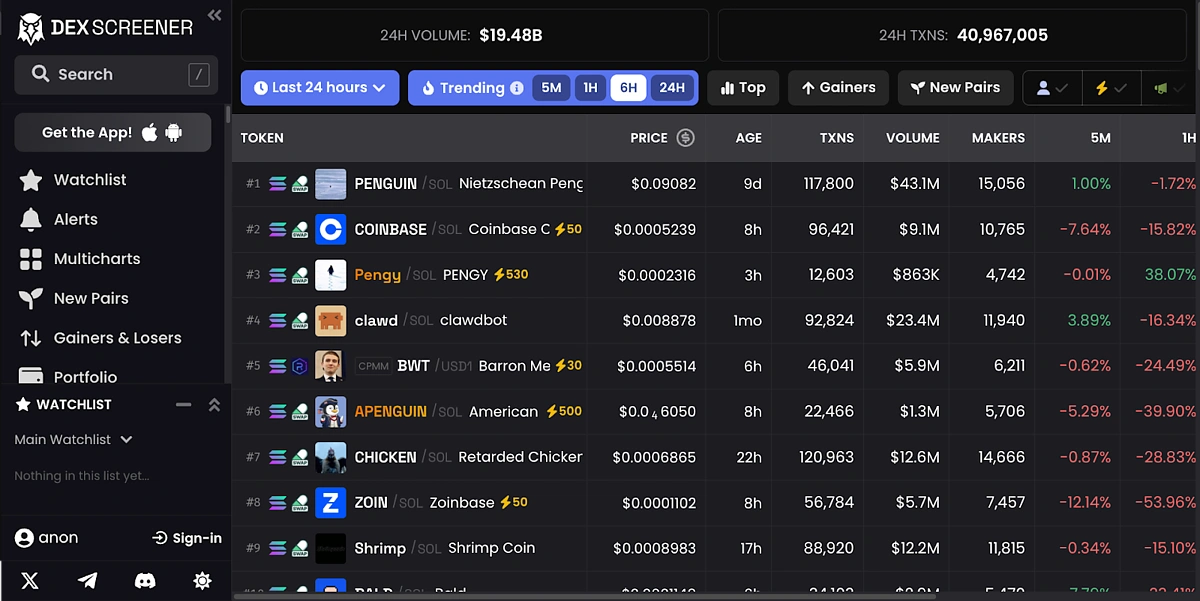
DexScreener is a pure DEX snapshot tool. It automatically indexes any token the moment a liquidity pool is created, and currently tracks over 2 million+ tokens across 80+ blockchain networks and 300+ DEXs. For developers building memecoin trackers or new token launch dashboards, DexScreener API also provides unique endpoints for community takeovers (CTOs) and platform-boosted tokens that no other provider in this list offers.
DexScreener API Strengths
-
1-second data updates across 2 million+ tokens on 80+ networks.
-
Zero-friction access with no API key, no signup, and no credit card required.
-
Unique social endpoints for community takeovers and boosted tokens.
-
Rate limits of 300 requests/minute for pair and pool queries, 60 requests/minute for profile data.
DexScreener API Weaknesses
The API only provides real-time snapshot data. There are no historical OHLCV endpoints, no WebSocket streaming, and no way to reconstruct past price charts. The Search endpoint results are also capped at 30 pairs only with no pagination controls, and there are currently no paid tiers available to scale past the hard rate limits. Developers should also note that DexScreener API's terms of service include a competitive restriction clause, making it unsuitable for building user-facing production applications that compete directly with DexScreener.
DexScreener API Pricing
-
Free Plan: Public API with rate limits (60 to 300 requests per minute depending on endpoint).
-
Lowest Paid Tier: Not available.
-
Highest Paid Tier: Not available.
-
Enterprise: Not available.
Who DexScreener API Is Best For
Traders tracking memecoin token activity and real-time DEX liquidity across a decent range of networks who do not need historical data.
7. Bitquery API
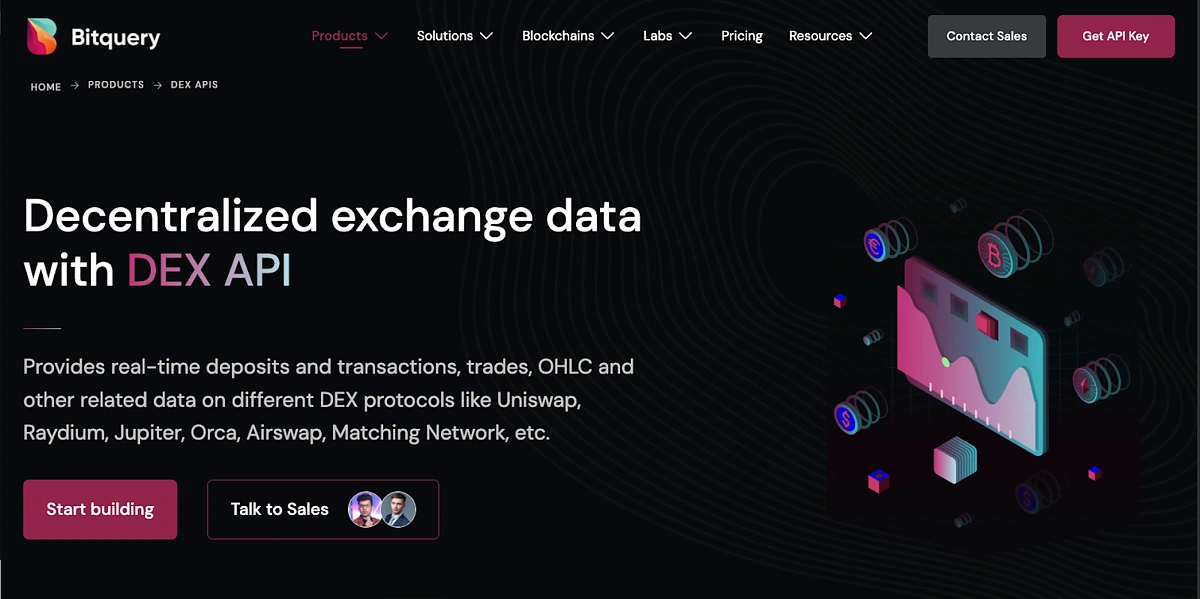
For developers who need direct access to raw blockchain data, Bitquery is an onchain GraphQL infrastructure provider that indexes raw blockchain data across 40+ networks, going all the way back to genesis blocks. Instead of offering hundreds of REST endpoints, Bitquery routes all queries through 12 core GraphQL endpoints, letting developers construct custom queries for DEX trades, token balances, smart contract events, mempool transactions, and NFT marketplace activity. For developers building MEV bots, arbitrage trackers, or onchain analytics dashboards, this flexibility is the main advantage. Bitquery also offers three distinct streaming options: GraphQL WebSocket subscriptions, Kafka, and CoreCast gRPC streams specifically optimized for the Solana network.
Bitquery API Strengths
-
Full historical depth back to genesis blocks across 40+ blockchain networks.
-
Mempool API that simulates unconfirmed transactions to detect MEV opportunities before onchain confirmation.
-
Three streaming options (WebSocket, Kafka, gRPC) with latency ranging from sub-100ms to 1 second.
-
Pre-computed analytics including 1-second OHLC candles, moving averages (SMA, WMA, EMA), and cross-chain token price aggregation.
Bitquery API Weaknesses
Bitquery API uses a points-based billing system that is opaque and resource-dependent. A query that spans a large historical time range without setting a strict row limit can consume far more points than expected, and the free Developer Plan only includes 1,000 trial points. Paid plans start at $29/month (Personal, no streaming), with Pro at $69/month (100 concurrent streams) and Scale at $199/month (1,000 concurrent streams). Bitquery also does not provide standardized CEX price data, so it cannot serve as a standalone market data source for applications that need both centralized and decentralized exchange coverage. The need for GraphQL expertise and custom query construction makes the technical barrier significantly higher than REST-based alternatives, where the same onchain pool data, OHLCV, and trader analytics are accessible without writing custom queries.
Bitquery API Pricing
-
Free Plan: Developer Plan with 1,000 trial points, 10 requests/minute, 2 simultaneous streams.
-
Lowest Paid Tier: Personal at $29/month for personal use only.
-
Highest Paid Tier: Scale at $199/month
-
Enterprise: Custom pricing, dedicated Kafka instances, cloud data exports (Parquet to S3, BigQuery, Snowflake).
Who Bitquery API Is Best For
Developers with deep experience in GraphQL implementations who need raw onchain transaction monitoring, mempool data, MEV tracking, or ultra-low-latency Solana streaming.
8. Glassnode API
For researchers and institutional investors who need deep onchain intelligence, Glassnode API specializes in entity-adjusted metrics. A single person or exchange can control thousands of wallet addresses, which makes raw address-level data unreliable for understanding real wallet movements controlled by the same entity. Glassnode uses proprietary clustering algorithms to group those addresses into "entities," filters out internal shuffling, and surfaces the actual economic activity underneath. The result is a library of 800+ metrics across 23 categories (addresses, miners, derivatives, DeFi, mempool, and more) covering 1,700+ assets, delivered through a REST API, Snowflake data sharing, or a no-code Excel Add-in.
Glassnode API Strengths
-
Proprietary entity-adjusted metrics that filter out internal transactions to surface true network activity.
-
Point-in-Time data designed for backtesting, so historical values are not retroactively revised by later clustering updates.
-
Official Excel Add-in for quantitative researchers who work primarily in spreadsheets.
Glassnode API Weaknesses
The API has no free tier and cannot be self-served. API access is an optional paid add-on available only to Studio Professional plan subscribers ($999/month), and the exact cost of the add-on requires contacting their sales team. The bulk query endpoint is also a credit trap: it charges 1 credit per parameter combination returned, which means a single poorly scoped request can consume massive amounts of quota. API rate limits (600 requests/minute) are also shared with your Glassnode Studio web usage, so active dashboard browsing can eat into your programmatic API budget.
Glassnode API Pricing
-
Free Plan: None (API is strictly paid only).
-
Lowest Paid Tier: API add-on to the $999/month Studio Professional plan (price is enquiry-only).
-
Highest Paid Tier: Not available.
-
Enterprise: Custom pricing, bespoke institutional data delivery via Snowflake.
Who Glassnode API Is Best For
Macroeconomic researchers, hedge funds, and institutions building onchain valuation models who need entity-level behavioral data that raw blockchain APIs cannot provide.
Best Free CoinGecko API Alternative
For most developers, CoinGecko's free Demo plan is still the best free crypto price and market data API. It provides 10,000 monthly credits across 50+ endpoints, one year of daily historical data, and a flat credit model where every successful call costs exactly 1 credit. Credits reset every month, and polling before the cache refreshes does not consume a credit. If you are evaluating something else, here is how the alternatives compare.
CoinPaprika's free plan offers 20,000 monthly calls, which looks stronger until you look at what is actually accessible. The free tier is capped at 2,000 coins, compared to CoinGecko's 22,000+ coins and 48M+ tokens. Price data updates every 5 to 10 minutes, slower than CoinGecko's 60-second cache on the free tier. OHLCV data is restricted to 24-hour intervals and only the last 1 day of history. For developers who need broader market coverage or any level of granularity beyond daily candles, CoinPaprika's free plan may not be sufficient.
CoinMarketCap's free plan offers 10,000 monthly credits, the same as CoinGecko's free Demo plan. However, it restricts access to 30 endpoints, includes zero historical data, and charges a credit on every call even when you're retrieving the same cached data within the cache period.
For the specific cases where another provider's free tier genuinely makes sense, Bitquery's 1,000-point Developer Plan is a starting point for raw onchain data. For most developers building production crypto applications, switching to a different free-tier provider is unlikely to unlock meaningfully more than CoinGecko's free Demo plan already covers.
Which Crypto Data API Do Developers Recommend?
To understand the broader landscape of crypto API providers, it is helpful to look at which crypto data APIs developers are actually using. We sourced data from GitHub for repositories mentioning each provider's name and treated them as an indicator of developer usage. This allows us to see which crypto API provider gets the most ongoing attention, activity, and word-of-mouth recommendations.
Here is how the top major crypto data API providers compare as of July 2026:
| Provider | GitHub Activity (July 2026) |
|---|---|
| CoinGecko | 540 |
| CoinMarketCap | 101 |
| DexScreener | 68 |
| Glassnode | 5 |
| CoinPaprika | 18 |
| CoinDesk | 10 |

Source: Crypto API Github Activity Tracker
The majority of crypto developers choose CoinGecko API as their primary data provider for building production applications and everyday projects. CoinMarketCap API holds a consistent second position, while DexScreener API has recently gained momentum as onchain token launches and memecoin trading activity increases.

Which Crypto API Should You Choose?
Every crypto application has different data requirements, and the right API depends on what you are building. Here is how to match your use case to the most suitable provider.
Crypto and Web3 Wallets
If you are building a crypto or Web3 wallet, broad token coverage is the most important factor. Your users expect to see balances and prices for tokens across dozens of networks, including long-tail assets. CoinGecko API tracks over 48 million+ onchain tokens across 360+ networks, which is the broadest coverage in the industry. CoinMarketCap covers 2.4 million+ tokens across 120+ networks, which may be sufficient for wallets focused on major assets.
Quantitative Trading and HFT Systems
If you are building quantitative trading strategies or HFT systems, the priority shifts to latency, tick-level OHLCV history, and order book depth. CoinDesk API and CoinAPI both offer sub-second granularity with Level 2 order book data and 10+ years of historical depth.
DeFi Dashboards and DEX Analytics Tools
If you are building a DeFi dashboard or DEX analytics tool, you need pool-level data, liquidity tracking, and the ability to filter across thousands of trading pairs. CoinGecko's onchain API covers 1,900+ DEXs with features like the Pools Megafilter, honeypot detection, and 1-second OHLCV granularity. For teams that need raw mempool access or sub-100ms streaming on Solana specifically, Bitquery is the more specialized option, though it requires GraphQL expertise and carries a steeper learning curve.
Crypto Exchanges
If you are running a crypto exchange, you need fast, reliable metadata and broad token databases to auto-populate trading pages as new assets launch. CoinGecko API's coverage of 48M+ tokens across 360+ networks and 1,900+ exchanges makes it well suited for this use case. Furthermore, its independently verifiable aggregation methodology is ideal for institutions that need to meet strict regulatory requirements, such as MiCA compliance.
Cross-Chain Swaps and Routing Infrastructure
If you are building cross-chain swaps or routing infrastructure, you need onchain data and liquidity metrics internalized into your routing algorithms. CoinGecko's onchain API provides pool-level liquidity and reserve data across 360+ networks, while Bitquery's onchain streams offer deeper transaction-level visibility for advanced routing logic.
Training AI Models
If you are training AI models, you need deep historical datasets with explicit commercial licensing. CoinAPI provides over 14 years of tick-level history, and CoinGecko API offers over 10 years of granular historical data with AI training commercial licensing available as an add-on.
Why CoinGecko API Remains the Top Choice
After evaluating these alternatives, each provider in this guide has genuine strengths in their respective niches. But when you weigh all of the dimensions together, here is why the majority of developers continue to choose CoinGecko API.
-
Broadest data coverage across markets: CoinGecko API tracks 22,000+ coins and 48M+ onchain tokens across 360+ networks, and a full range of data types spanning futures, derivatives, public treasuries, NFT floor prices, trending data, and crypto news aggregated from 100+ publishers. This means applications built on CoinGecko API stay current with the market automatically. In a market that moves as fast as crypto, that breadth of coverage means fewer gaps in your data and fewer moments where your users encounter assets your platform does not support yet.
-
Independent and accurate data: CoinGecko is not owned by or affiliated with any exchange, meaning there is no commercial incentive to inflate volumes. CoinGecko's proprietary aggregation methodology processes raw exchange feeds to remove wash trading and price outliers, delivering a highly reliable global average. This verifiable data integrity has directly enabled clients like Deblock to achieve the strict MiCA compliance required to operate as Europe’s first onchain bank.
-
Transparent, predictable pricing: CoinGecko API charges exactly 1 credit per successful API response regardless of parameters, with batch requests, pagination, and multi-currency conversions counting as a single call. Teams can forecast exactly what their API spend will look like before committing to an upgrade. In contrast, CoinAPI charges per data point returned, Bitquery uses a points system where a single query can consume unpredictable amounts of quota, CoinMarketCap gates OHLCV data behind higher-tier plans, and CoinDesk and Glassnode require contacting sales for pricing details.
-
Real-time data that scales with your plan: CoinGecko API's data latency progressively improves as you scale. The free Demo plan caches data at 60 seconds, Basic at 10 seconds (cacheless on selected onchain endpoints), and from the Analyst plan onwards developers get cacheless REST endpoints returning real-time data directly from CoinGecko's servers. On the DEX side, WebSocket streaming delivers onchain trades at sub-second intervals and OHLCV at 1-second intervals across 360+ networks, without requiring developers to run their own nodes or manage raw blockchain infrastructure.
-
Multiple ways to access data across any workflow: CoinGecko API is designed to meet developers, analysts, and AI systems where they already work. Engineers can access data through REST, WebSocket, and Webhook APIs, covering on-demand queries, real-time streaming, and automated push delivery in a single subscription. For the growing AI ecosystem, CoinGecko provides a complete AI-native tool stack, allowing AI agents to connect autonomously through an MCP server, CLI, agent skills, and x402 endpoints. Meanwhile, data and finance teams can pull live prices directly into spreadsheets via a no-code Google Sheets and Microsoft Excel Add-on.
-
Enterprise-grade reliability: CoinGecko API's Enterprise plan includes a 99.9% uptime SLA, SOC 2 Type 2 certification, a dedicated Customer Success Manager, 24/7 Slack support, custom rate limits, team management features, and commercial licensing for data redistribution.
Conclusion
Each alternative in this guide serves a specific niche well. CoinDesk and CoinAPI are suited for teams that need tick-level CEX data for quantitative trading. Bitquery is built for developers who need raw blockchain access and mempool data for MEV strategies. Glassnode serves institutional researchers who need entity-adjusted onchain metrics. CoinMarketCap works if your requirements are basic and your project does not need real-time streaming, or broad historical data and asset coverage beyond major coins.
For everything else, CoinGecko API delivers the best overall balance of coverage, data latency, flexible delivery (REST, WebSocket, and Webhook), commercial accessibility at $29/month, developer experience, and cost, with a clear path to real-time streaming and event-driven push delivery as teams grow.
Join the thousands of crypto developers who use CoinGecko API for comprehensive and reliable crypto market data. From individual builders testing their first API integration to Web3 wallets, cross-chain swaps, and crypto exchanges serving millions of users, CoinGecko API is built to scale with you at every stage of your project. Sign up for a free CoinGecko Demo API plan today and start building.







 Or check it out in the app stores


