




 Make us preferred on Google
Overview of Top Solana Bridges
What Are Blockchain Bridges?
Blockchain bridges address a core limitation in crypto: different blockchains cannot directly interact with one another. Ethereum, Solana, and BNB Chain each function as separate networks with distinct architectures and native assets. Bridges act as intermediaries that facilitate asset transfers between these otherwise incompatible systems, allowing users to move assets across chains while maintaining security and decentralization
How Bridges Work
Bridges use several mechanisms to transfer assets between chains. Traditional bridges employ a lock-and-mint model where tokens are locked on the source chain while wrapped versions are minted on the destination chain. To illustrate this, when you bridge ETH to Solana on a traditional bridge, that ETH would be locked on Ethereum and a corresponding amount of “wETH” will be minted on Solana. While this solution works, it has known security vulnerabilities, the locked ETH becomes a target for smart contract exploits. If the locked assets of these traditional bridges are drained, wETH will depeg and essentially become worthless. This scenario was seen during the Multichain exploit.
To counteract this vulnerability, modern native bridging solutions rely on building crosschain native token standards and employing a burn-and-mint model. LayerZero’s OFT, Wormhole’s NTT and Circle’s CCTP are examples of this model where tokens are natively burnt on one side and minted on the other in this bridging method. This solution enables tokens to exist natively across multiple chains without wrapping, maintaining a unified supply. In this solution, there are no locked assets that attackers can exploit and drain.
Another popular bridging solution is intent-based bridges, which use competitive solver networks to fulfill cross-chain transfers. Instead of locking assets or requiring native token standards, users simply express their desired outcome (an "intent") — for example, "I want SOL on Solana." Professional market makers called solvers compete to fulfill this request by providing tokens on the destination chain immediately, then claiming the user's source tokens afterward.
This approach eliminates the need for wrapped tokens entirely and often provides faster execution (1-5 minutes) with better pricing due to solver competition. Examples include Mayan Finance and deBridge's DLN (deBridge Liquidity Network). The key advantage is flexibility — intent-based bridges can work with any token without requiring special standards or creating wrapped versions.
What Makes a Bridge Trustworthy?
Several factors determine a bridge's reliability and security:
-
Decentralization of validators/custodians: More independent validators means no single point of failure.
-
Total value locked (TVL): The amount of assets secured by the bridge demonstrates user confidence and raises the stakes for maintaining security.
-
Security audits: Professional third-party reviews of the bridge's code, although not fool-proof lends better credibility.
-
Track record: A longer time in operation (ideally 1+ years) without major hacks or exploits is preferred.
-
Insurance or security funds: Protocols that maintain reserves to compensate users in case of exploits.
-
Financial backing: Bridges built or backed by reputable financial institutions or large VC funding suggests greater resources for security audits, bug bounties, and rapid incident response.
Now let's examine the top five bridges serving the Solana ecosystem.
1. Wormhole
Type of bridge: Lock-and-mint with a decentralized validator network (Guardian network)
Wormhole stands as the most established and widely-used bridge connecting Solana to other blockchains. Launched in October 2021, Wormhole has evolved into a comprehensive cross-chain messaging protocol that supports not just asset transfers but also cross-chain data and application communication across more than 30 blockchain networks. Users primarily access Wormhole through Portal, the main user-facing application built on Wormhole's infrastructure, providing a streamlined interface for everyday users to bridge assets to and from Solana.
Key Metrics
-
Total Value Locked: As of writing, over $2 billion in assets are secured by Wormhole bridges.
-
Bridge volume: Processes $300-500 million in volume weekly, by far the largest as of writing.
-
Launch date: October 2021.
-
Notable team or investors: Initially developed by Jump Crypto and spun off as an independent entity in 2023; raised $225 million at a $2.5 billion valuation from Brevan Howard, Coinbase Ventures, Multicoin Capital, ParaFi, Dialectic, Borderless Capital, Arrington Capital, and Jump Trading.
How Wormhole Works
Wormhole employs a network of 19 Guardians (independent validator nodes that observe transactions on source chains and attest to their validity) who monitor transactions across connected chains. When you initiate a bridge transfer, at least 13 of the 19 Guardians must verify and sign off on the transaction before it completes on the destination chain. This creates a distributed security model where no single entity controls asset transfers.
Costs and Speed
-
Typical bridging cost: Bridging cost depends on your source chain, and bridge configuration. A typical bridge of USDC to Solana from an ETH L2 such as Arbitrum would cost ~$0.50 after accounting for gas fees.
-
Transfer time: Generally 5-20 minutes depending on network congestion and source chain confirmation requirements. Bridging USDC via CCTP is the most cost effective but generally slower bridging times. It is worth mentioning that Portal routes bridge transactions through Mayan Finance’s Swift when the “Fastest” option is selected, which has arrival times of <1 minute.

Unique Features
Native USDC Support: Wormhole partnered with Circle to enable native USDC transfers using Circle's Cross-Chain Transfer Protocol (CCTP), allowing users to move genuine USDC rather than wrapped versions between supported chains, eliminating the need to swap wrapped tokens back to native ones.
Comprehensive Ecosystem: Beyond simple asset bridging, Wormhole supports cross-chain governance, NFT transfers, and messaging between decentralized applications. Mayan’s Swift intent-based bridging solution utilizes Wormhole’s secure messaging network.
Recovery Ability: Wormhole suffered a massive exploit in February 2022 that resulted in $325 million in losses. The losses were fully repaid by Jump Crypto, one of their financial backers, and showcases the importance of having a strong financial backing.
2. Mayan Finance
Type of bridge: Intent-based bridge.
Mayan Finance represents a newer generation of bridging technology that uses competitive auctions rather than traditional lock-and-mint or liquidity pool models. Launched in 2022, Mayan focuses on providing the fastest possible cross-chain swaps by leveraging a network of professional solvers (specialized market makers who compete to fulfill cross-chain swap orders by providing liquidity on the destination chain).
Key Metrics
-
Total Value Locked: TVL is not recorded/needed.
-
Bridge volume: Usage of their bridge has been growing with weekly volumes at around $200-$300 million.
-
Launch date: 2022.
-
Notable team and investors: Backed by Solana Ventures, Jump Crypto, and several DeFi-focused funds; the team includes developers with backgrounds in decentralized exchange design and cross-chain protocols.
How Mayan Works
Rather than locking assets in a bridge contract, Mayan creates an auction where solvers compete to fulfill your swap request. When you want to bridge USDC from Ethereum to Solana, Mayan broadcasts your request to its solver network. Solvers bid to complete your swap by offering you tokens on Solana immediately, then they claim your USDC on Ethereum afterward. Competition between solvers drives down costs and speeds up execution.
This creates a fundamentally different security model: instead of trusting validators or liquidity pools, you're relying on economic incentives where solvers only profit if they complete transfers honestly and competitively.
Costs and Speed
-
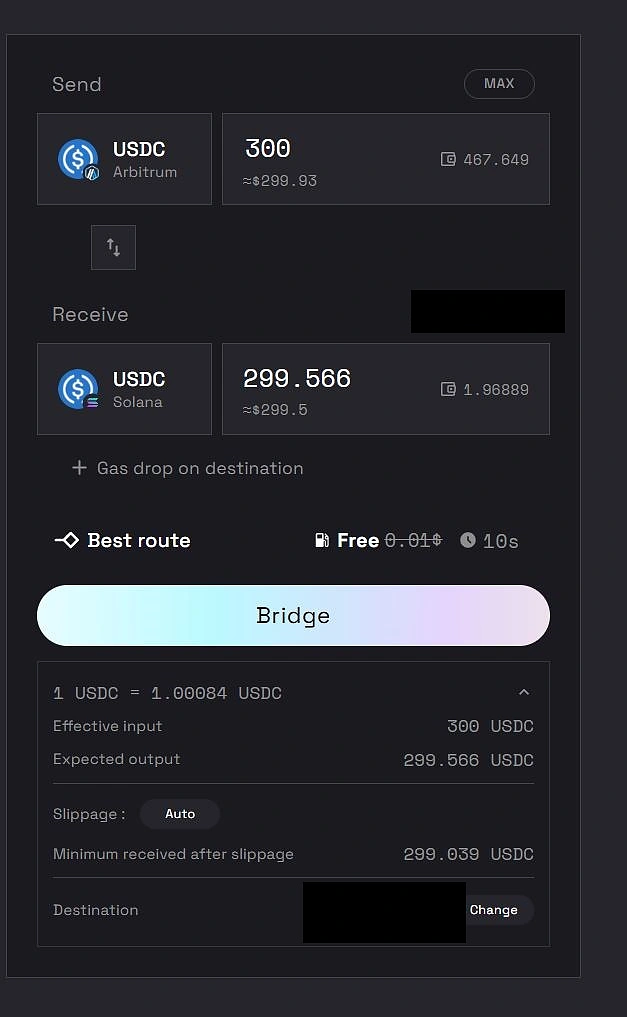
Typical bridging cost: Mayan charges a fixed protocol fee of 0.1% of the transfer amount, which is significantly lower than many competitors. The total cost depends on the source chain's gas fees and network conditions. A simulated transaction bridging USDC from the ETH L2 Arbitrum shows costs of ~$0.50 to $1.
-
Transfer time: <1 minute in most cases, significantly faster than validator-based bridges.
Unique Features
Near-instant swaps: Because solvers provide liquidity on the destination chain immediately rather than waiting for cross-chain message verification, Mayan often completes transfers in under 2 minutes, making it the fastest option for many routes.
Competitive pricing: The auction mechanism ensures users typically receive better exchange rates than fixed-fee bridges, as solvers compete on price to win order flow.
Direct token swaps: Like deBridge, Mayan allows you to bridge and swap in one transaction, but with potentially better pricing due to the competitive solver market.
Lower capital requirements: Because Mayan doesn't require massive locked liquidity pools, it can support more token pairs and chain combinations than liquidity-based bridges, making it useful for bridging less common tokens.
3. deBridge
Type of Bridge: Hybrid, utilizing both lock-and-mint and intent-based bridging.
deBridge has emerged as a leading alternative to Wormhole, offering a different security model that emphasizes economic incentives and independent validation. Launched for Solana in 2021, deBridge focuses on creating trustless cross-chain infrastructure with strong security guarantees through economic staking mechanisms.
Key Metrics
-
Total Value Locked: deBridge uses a 0-TVL required, cross chain trading mechanism (DLN).
-
Bridge Volume: deBridge processes $200 million in weekly volume, similar to Wormhole.
-
Launch Date: 2021 (Solana support).
-
Notable Team or Investors: Backed by ParaFi Capital, Animoca Brands, Huobi Ventures, and others.
How deBridge Works
deBridge is an intent-based bridge. Traditional bridges require you to navigate complex multi-step processes (locking tokens, minting wrapped versions, waiting for confirmations). With deBridge, you just state your desired outcome and the protocol executes it for you.
Instead of relying on locked funds in liquidity pools, deBridge uses a competitive network of professional market makers (called "solvers") who fulfill user requests in seconds using their own capital. This allows deBridge to operate without dedicated liquidity pools, making it safer from the large-scale exploits that have plagued traditional bridges.
Costs and Speed
-
Typical bridging cost: deBridge uses a dynamic fee structure that varies based on network conditions and transfer route. The bridging fee is broken down into 2 main components, Solver gas costs and deBridge’s fee. A typical bridge of USDC from an ETH L2 would cost ~$5 in total.
-
Transfer time: deBridge’s key branding is “lightspeed” cross-chain transfers, meaning Instantaneous bridging times of <1 second.

Unique Features
Instantaneous transfers: deBridge’s main selling point is its easy to use interface and “lightspeed” transfers. Expect transactions to land instantly, with few to little wait time albeit at higher transaction costs.
4. Allbridge
Type of bridge: Liquidity pool-based bridge
Allbridge takes a different approach from Wormhole and deBridge by utilizing liquidity pools on each supported chain rather than relying purely on lock-and-mint mechanisms. Launched in 2021, Allbridge focuses on supporting a wide range of chains including many that other bridges don't serve, making it particularly useful for bridging from smaller or newer blockchain networks to Solana.
Key Metrics
-
Total Value Locked: At its peak in 2022, Allbridge TVL averaged at over $400 million. After FTX’s collapse, Allbridge has a more modest but still significant average TVL of over $40 million.
-
Bridge volume: Allbridge processes relatively lower weekly volumes of $1-2 million.
-
Launch date: 2021.
-
Notable team or investors: The team operates with a relatively lower public profile compared to Wormhole and deBridge, with backing from several less established crypto investment firms such as AngelONE Capital, Black Mamba Ventures and Exnetwork Capital.
How Allbridge Works
Allbridge maintains liquidity pools of stablecoins on each supported chain. When you bridge USDC from Polygon to Solana, you essentially swap your USDC into Allbridge's Polygon pool, and receive USDC from Allbridge's Solana pool. A small network of validators oversees pool operations and verifies cross-chain messages, using a multisig approach (a security model requiring multiple designated parties to approve transactions before they execute, similar to requiring multiple signatures on a business check).
Costs and Speed
-
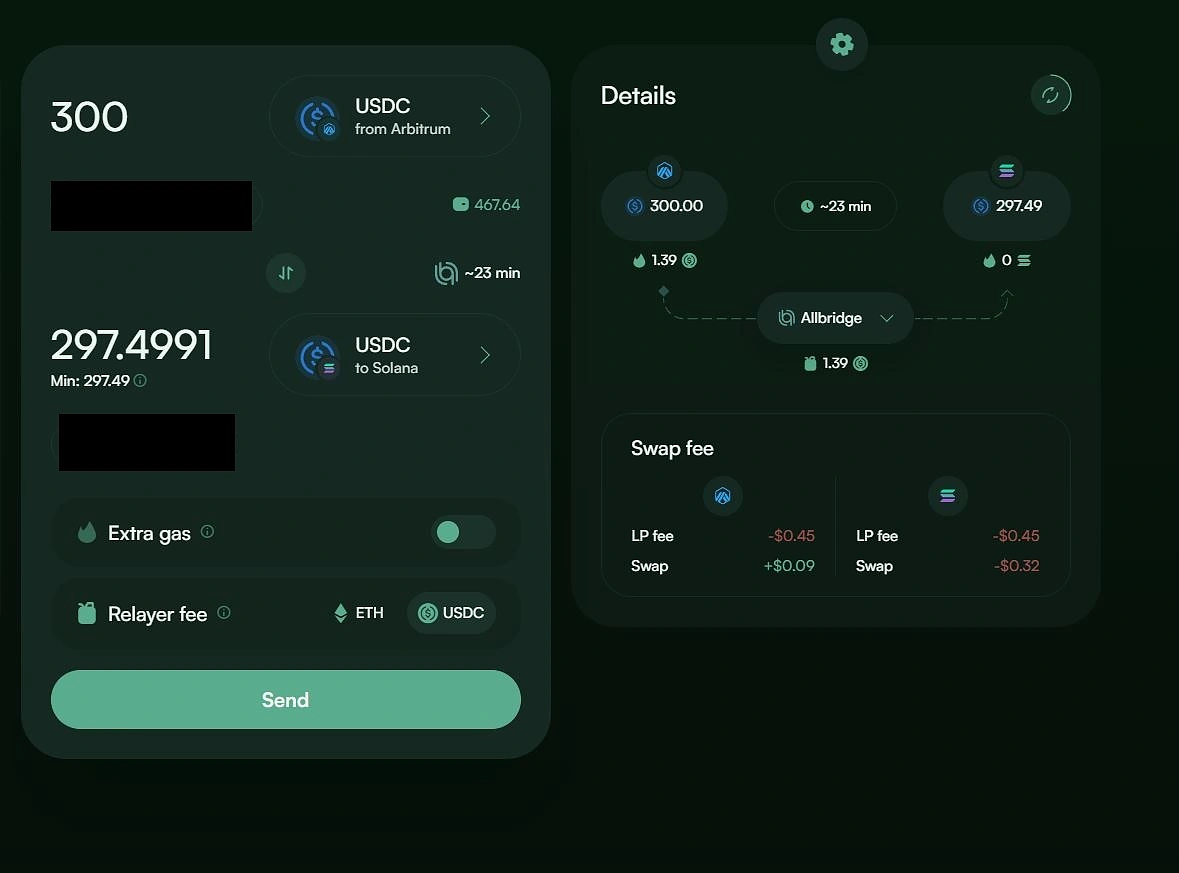
Typical bridging cost: Allbridge charges a bridge fee of 0.3% of the transfer amount, paid in the same token being transferred. The same 300 USDC simulated transaction from Arbitrum to Solana shows costs of ~$2.50 in total, broken down into two parts, Allbridge’s fees as well as a relayer fee.
-
Transfer time: ~20 minutes.
-
Slippage considerations: Large transfers may experience slippage (the difference between expected and actual execution price due to limited liquidity), where you receive slightly less than expected if pool liquidity is limited.
Unique Features
Wide Chain Support: Allbridge supports bridging from numerous chains to Solana including Celo, Fuse, and other networks not covered by major bridges, making it valuable for accessing Solana from less common ecosystems.
Stablecoin Focus: The protocol specializes in stablecoin transfers, optimizing its pools and fee structures for USDC, USDT, and other stablecoins rather than trying to support every token type.
Lower Fees on Smaller Chains: Because many of the chains Allbridge supports have lower gas fees than Ethereum, bridging through Allbridge from these chains to Solana is often more economical than using Ethereum-based bridges.
5. Synapse Protocol
Type of bridge: Optimistic bridge with cross-chain AMM (Automated Market Maker) integration
Synapse Protocol offers a hybrid approach that combines bridging with decentralized exchange functionality, allowing users to not only move assets between chains but also swap between different tokens as part of the bridging process. Launched in 2021, Synapse has built a reputation for supporting a wide variety of chains with generally reliable service and competitive pricing.
Key Metrics
-
Total Value Locked: Once held over $1 billion in TVL in the past, Synapse TVL has been on a decline and currently sits at around $20 million.
-
Bridge volume: About $1 million in weekly volume.
-
Launch date: 2021.
-
Notable team and investors: Backed by Framework Ventures, Coinbase Ventures, and several DeFi-focused investment firms; the team includes experienced developers from the Ethereum DeFi ecosystem.
How Synapse Works
Synapse employs an optimistic verification model where transactions are assumed to be valid and executed quickly, with validators able to dispute fraudulent transactions during a challenge period. The protocol maintains liquidity pools on each supported chain, similar to Allbridge, but also incorporates cross-chain AMM (Automated Market Maker) functionality that allows users to swap tokens across chains in a single transaction.
Costs and Speed
-
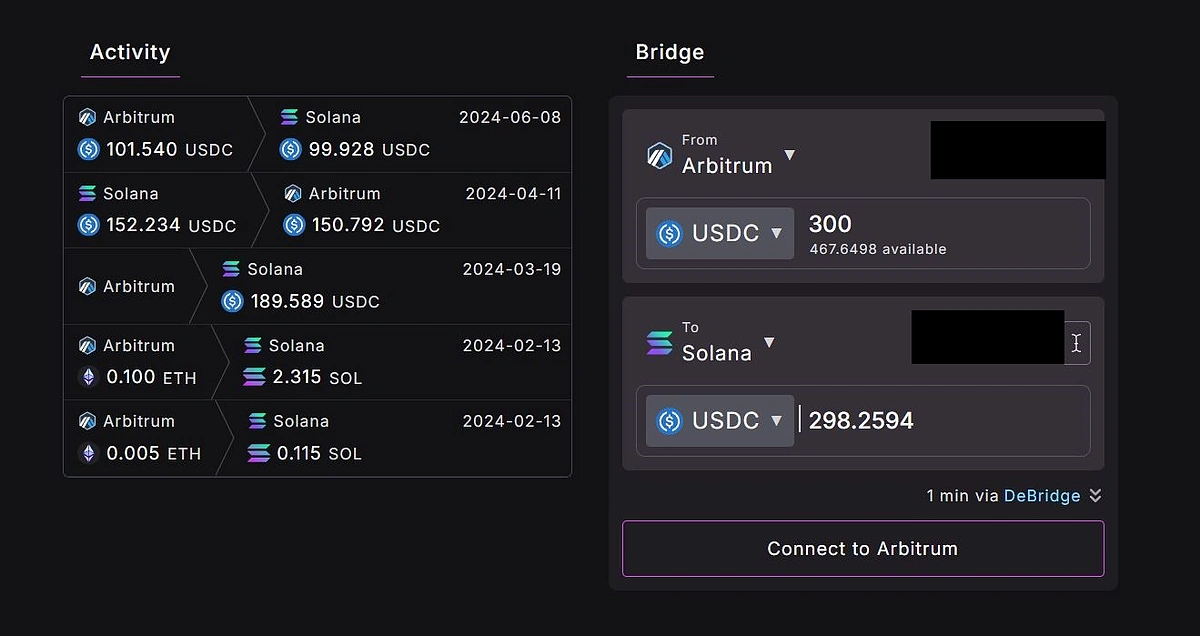
Typical bridging cost: Synapse uses a multi-component fee structure that includes swap fees, bridge fees, and admin fees. The total cost varies dynamically based on network conditions, liquidity availability, and the specific transfer route. Our simulation shows total costs of ~$1.80 when bridging USDC from Arbitrum to Solana where Synapse routes the transaction through deBridge. Synapse appears to use deBridge’s slower model as evident from the non-instantaneous transfer time.
-
Transfer time: ~1 minute.
Unique Features
Broad token support: Beyond just major tokens, Synapse supports a wide range of DeFi tokens and stablecoins, making it useful for bridging less common assets that other bridges may not support.
Note: Synapse has experienced significant TVL decline. Users should verify current liquidity before large transfers
Comparing the Top 5 Solana Bridges
|
Criteria |
Wormhole |
Mayan Finance |
deBridge |
Allbridge |
Synapse |
|
Security Model |
Decentralized validator network (19 Guardians) |
Intent-based with competitive solvers |
Decentralized validator network with staking |
Small validator set + multisig |
Optimistic validation |
|
Speed |
Slow (5-20 min) |
Faster (<1 min) |
Fastest with DLN (<1 sec) |
Slower (~23 min) |
Fast (1 min) |
|
Cost |
Low to Moderate, scales with gas |
Low (Swift) |
High (DLN mode) |
Moderate |
Moderate |
|
Ease of Use |
Manual claim step (confusing) |
Simplest (one-click) |
Straightforward |
Functional but basic |
Straightforward |
|
Chain Support |
30+ chains |
Select chains |
Major chains only |
20+ chains |
20+ chains |
|
Key Features |
Developer messaging tools, broad coverage |
Direct swaps, optimized routing |
Direct cross-chain swaps, DLN |
Wide chain support, stablecoin focus |
Liquidity farming, cross-chain AMM |
Choosing the Right Bridge for Your Needs
Choosing the Right Bridge for Your Needs
For beginners: Mayan offers the simplest one-click experience. If your chain isn't supported, try deBridge or Synapse for their straightforward interfaces. Avoid Wormhole unless necessary—the manual claim step is confusing.
For speed: deBridge DLN is by far the fastest option (instantaneous), but Mayan Swift is also compelling as an alternative option for speed (<1 min) with reasonable cost.
For large transfers: Prioritize Wormhole or deBridge for their decentralized validator networks and proven track records with high-value assets.
For lowest cost: Compare quotes between Allbridge (0.3% fee) and Mayan (0.1% fee), though remember that source chain gas fees often matter more than bridge fees.
For rare/emerging blockchains: Wormhole supports 30+ chains including niche networks. Allbridge is your second-best option for unusual Layer 1s.
Security Best Practices
Regardless of which bridge you choose, follow these safety guidelines:
-
Perform test transactions: Test bridges with small amounts before transferring significant value.
-
Verify website addresses: Double-check that you're using official bridge websites (bookmark them after verifying).
-
Check liquidity: For liquidity pool bridges like Allbridge, verify sufficient pool depth before large transfers to avoid excessive slippage.
-
Monitor transactions: Keep track of transaction hashes on both source and destination chains.
-
Split up your transactions: For very large transfers, consider splitting/staggering them to avoid bad slippage due to low liquidity.
-
Stay informed: Follow bridge protocols on social media for security announcements and network status updates.
Conclusion
Blockchain bridges are essential infrastructure for accessing Solana's high-performance ecosystem from other chains. While each bridge offers different trade-offs between speed, cost, security, and decentralization, the top five bridges: Wormhole, deBridge, Mayan Finance, Allbridge and Synapse Protocol — provide reliable options for most users' needs.
As with all crypto infrastructure, no bridge is perfectly secure or risk-free. Understanding how each bridge works, following security best practices, and choosing the right tool for your specific needs will help you safely navigate the cross-chain landscape. Start with small test transactions, use reputable bridges with strong track records, and always verify you're interacting with legitimate protocol websites.
This article is for educational and informational purposes only and should not be construed as financial advice. Cryptocurrency bridges carry inherent risks including smart contract vulnerabilities, validator failures, and potential loss of funds.









 Or check it out in the app stores


