





 Make us preferred on Google
TL;DR: Which Crypto Webhook API Should You Use?
CoinGecko Webhooks support market-data events, while Alchemy, Moralis, Helius, and QuickNode focus on onchain events tied to specific wallets, contracts, or transactions.
- Market-wide events such as metadata changes, price alerts, and new listings: CoinGecko API.
- Wallet, contract, or onchain transaction events: Alchemy, Moralis, Helius, or QuickNode.
- Production apps may need both layers for market-data and onchain events.
Most crypto applications check for updates on a schedule. A price tracker polls every few seconds, a compliance script checks token metadata every hour, and a wallet re-scans a batch of addresses on a cron job. Polling works well when regular checks are enough, while webhooks deliver updates as events occur.
A webhook uses a different approach. Your server registers an endpoint once, and the provider sends a request when an event occurs instead of your application polling for updates. This can reduce API requests and provide real-time updates.
Crypto webhooks can deliver different types of events, depending on the provider. These include market-data events such as price, metadata, and listing-status changes, and onchain events like confirmed transactions, contract logs, and token mints.
This guide compares five crypto webhook APIs, including CoinGecko, Alchemy, Moralis, Helius, and QuickNode, and explains which use cases each one is best suited for.

How to Choose a Crypto Webhook API
All five providers use HTTP-based webhooks. The differences that matter are the events, coverage, delivery behavior, security, and filtering each provider supports:
Supported event types
Evaluate providers based on the specific events your application needs to react to.
Chain and market coverage
Coverage includes the chains, exchanges, and markets supported by each provider. It determines whether one provider can meet your needs or whether you need multiple providers for full coverage.
Delivery reliability and retry behavior
Review how failed deliveries are handled, including retry attempts and backoff, since temporary outages can otherwise result in missed events.
Authentication and payload security
Webhook endpoints are publicly accessible. Signature verification confirms that a payload came from the provider before it is processed.
Event filtering
Filtering determines whether applications can subscribe only to the addresses, coins, or event types they need, or receive a broader stream and filter it after delivery. Both approaches can work. With a broader stream, the application can check each payload against its watchlist before processing it.
Crypto Webhook APIs at a Glance
CoinGecko supports market-data webhooks for coin metadata, price alerts, and new listings across its tracked catalog. The other four focus on onchain events, including activity from specific wallets, contracts, and transactions.
Here’s how the five providers compare across the key factors:
| Criterion | CoinGecko | Alchemy | Moralis | Helius | QuickNode |
|---|---|---|---|---|---|
| Event types |
|
|
|
|
|
| Coverage |
|
|
|
|
|
| Reliability |
|
|
|
|
|
| Entry pricing |
|
|
|
|
|
| Filtering |
|
|
|
|
|
| Best for | Wallets, exchanges, portfolio trackers, and analytics dashboards syncing coin metadata, with price alerts and new-listing events for automated workflows | EVM dApps and exchanges monitoring wallet activity at scale | Multi-chain apps, cross-chain payment gateways, and wallets operating across EVM, Bitcoin, and Solana | Solana-native trading bots, NFT marketplaces, and compliance tools that need decoded transaction context | Teams needing broad onchain coverage or custom pipelines into Kafka, S3, or Postgres |
Best Crypto Webhook APIs (2026)
CoinGecko API: Best for Market-Data Webhooks

CoinGecko API is the most popular crypto price and market data API, trusted by industry leaders including MetaMask, Coinbase, and Etherscan. Webhooks bring that same data to your server in real time, delivering market-data events aggregated from exchanges and networks. This provides ready-to-use data without requiring you to index raw onchain activity.
Webhooks start at $29/month on the Basic plan, which includes WebSocket access and 100K monthly API credits. Selected plans also support crypto and stablecoin payments across six chains, a flexible payment option for crypto-native developers.
Pros
-
Broadest coverage: cg.coin.info.updated covers metadata, links, categories, and contract-address changes across every active tracked coin, including new-chain deployments and migrations, with no per-asset setup.
-
Flat pricing: 10 credits per delivered event, regardless of payload size, with free retries. Webhooks deliver updates as events occur, reducing repeated polling.
-
Transparent reliability: Failed deliveries retry with exponential backoff, with published auto-disable thresholds of 14 failed retries on one event over ~24 hours or 300 aggregate failures over 12 hours.
Cons
-
No upstream per-coin filtering:
cg.coin.info.updatedis a catalog-wide signal, so applications must filter events against their own watchlists usingdata.idanddata.changes[]. -
Private beta events: cg.coin.price.updated and cg.coin.listed are currently in private preview. Submit this form to get early access.
Alchemy: Production EVM Address Monitoring

Alchemy Notify focuses on wallet activity across EVM chains. Its Address Activity webhooks support 30+ EVM chains, with Solana support currently in early beta. NFT Activity and Custom Webhooks have narrower EVM-chain coverage and do not currently support Solana.
Pros
-
Address Activity: Supports up to 100,000 addresses per webhook. Custom Webhooks support custom GraphQL queries to define the addresses and log topics that trigger deliveries.
-
NFT Activity: Covers mints, sales, and transfers across Ethereum, Arbitrum, Optimism, and Polygon without requiring manual log parsing.
Cons
-
Payload-based pricing: Webhook costs scale with payload size at 0.04 compute units per byte, rather than a flat per-event model.
-
No aggregated market data: Focuses on onchain activity rather than aggregated coin metadata, prices, or listings.
Moralis: Wallet Activity Across EVM, Bitcoin, and Solana

Moralis Streams supports multi-chain applications such as payment gateways and wallets that would otherwise need separate integrations per chain. A single Streams setup delivers wallet and contract activity rather than raw blocks across 19 EVM mainnets, Bitcoin, and Solana.
Pros
-
Event filtering: Supports per-contract, per-address, and per-event filters across EVM, Bitcoin, and Solana from one dashboard.
-
Two-stage delivery: Sends a webhook when a transaction is first detected (
confirmed: false) and again when finalized (confirmed: true).
Cons
-
No replay protection: Moralis signs payloads with Keccak-256 via the
x-signatureheader, but the signature does not include a timestamp or nonce. A captured payload could therefore be replayed, requiring additional transaction verification for sensitive actions. -
Per-record pricing: EVM records cost 10 CU each, and a single delivery can contain transactions, logs, and internal transactions. A 100-token NFT mint can generate 100 records, costing 1,000 CU for one delivery.
Helius: Solana Transaction Data

Helius focuses on Solana, with Enhanced Webhooks that parse Solana transactions into labeled events such as NFT sales, token transfers, and swaps. It also offers Raw Webhooks for transactions involving watched addresses without event-type filtering.
Pros
-
Event parsing: Enhanced Webhooks provide labeled transaction events for use cases such as NFT marketplaces, trading bots, and compliance tools.
-
Filtering: Enhanced Webhooks support filtering by address list and transaction type to limit delivered events.
Cons
-
Basic authentication: Helius uses an optional static header rather than cryptographic payload signing. A leaked header can be replayed, and payload integrity cannot be verified. For sensitive actions, independently verify the referenced transaction signature on Solana before acting.
-
Limited retries: Failed deliveries are retried up to 3 times before the event is dropped. Delivery is at-least-once, so duplicate events are possible.
-
Additional credit charges: Each event costs 1 credit regardless of whether your endpoint processes it successfully. Creating, editing, or deleting a webhook costs 100 credits each.
QuickNode: Broad Onchain Coverage, Custom Data Pipelines
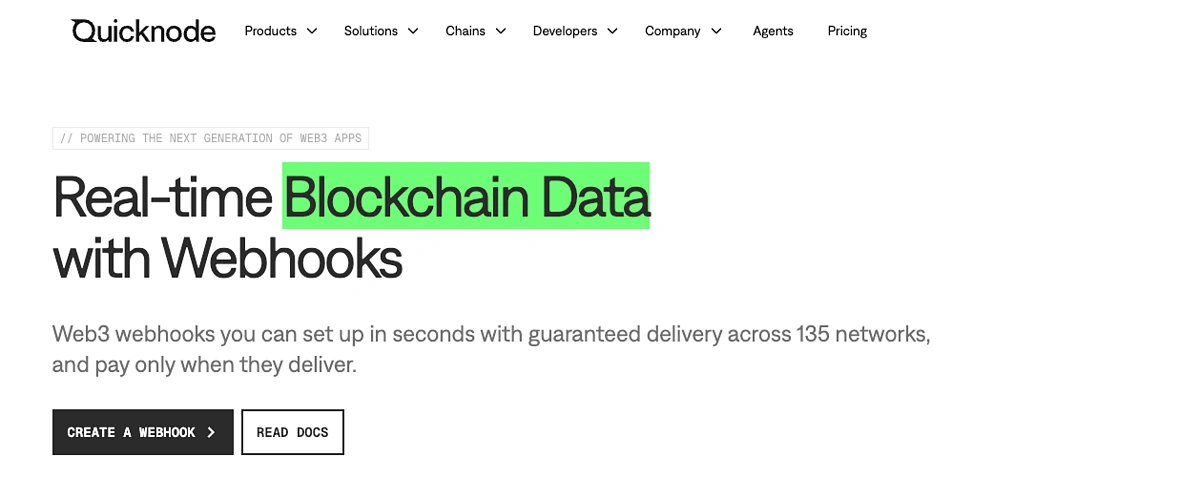
QuickNode Streams provides broad onchain coverage, raw blockchain data, and multiple delivery options beyond a single webhook endpoint.
Pros
-
Widest onchain coverage: EVM chains, Bitcoin, Solana, XRPL, and Stellar, with 50+ chains in total.
-
Custom data processing: Supports JavaScript and Go for filtering and transforming onchain data, from raw logs to decoded application events.
-
Multiple destinations: Streams can deliver to webhooks and data destinations such as Kafka, S3-compatible storage, Azure Blob Storage, or Postgres.
Cons
-
Raw data by default: Streams delivers block, log, receipt, and trace data. Turning this into decoded events such as ERC-20 transfers or swaps requires your own filtering and decoding logic.
-
Processing costs: QuickNode processes every block before applying the filters, so narrowing the events you receive does not reduce the 30-credit payload charge.
Which Crypto Webhook API Should You Choose?
CoinGecko's Webhooks are suited to market-data events, while Alchemy, Moralis, Helius, and QuickNode focus on onchain activity.
A production stack may use both. For example, a wallet app might use CoinGecko to keep coin metadata and prices in sync for its UI, while relying on Alchemy or Moralis to detect deposits and withdrawals. The providers therefore complement each other.
CoinGecko: Market-data events
-
cg.coin.info.updatedkeeps wallets, exchanges, portfolio trackers, analytics dashboards, and alert bots in sync when a project rebrands, migrates its contract address, or updates a link, without polling every tracked coin. -
cg.coin.listedsupports listing-alert products, asset-onboarding pipelines, trading terminals, multi-chain wallets, and social-sentiment tools that need to know when CoinGecko indexes a new coin. -
cg.coin.price.updatedsupports trading bots, price-alert apps, notification bots, and no-code automation platforms such as Zapier or IFTTT when a coin crosses a defined price threshold.
Alchemy, Moralis, Helius, and QuickNode: Onchain events
-
Alchemy: EVM applications tracking wallet activity at scale, with Address Activity supporting up to 100K addresses per webhook.
-
Moralis: Multi-chain applications across EVM, Bitcoin, and Solana through a single Streams API, such as multi-chain applications and payment gateways.
-
Helius: Solana applications that need decoded transaction events rather than raw transaction data, such as trading bots, NFT marketplaces, and compliance tools.
-
QuickNode: Applications needing broad onchain coverage, custom data processing, or multiple delivery destinations, including webhooks and data warehouses.
Conclusion
The right choice depends on the type of events your application needs. CoinGecko is suited to market-data events, including metadata syncing ,price alerts and new listings, while Alchemy, Moralis, Helius, and QuickNode focus on onchain address and transaction monitoring.
To learn more about implementing CoinGecko Webhooks, see the CoinGecko Webhook walkthrough, which covers endpoint setup, signature verification, and idempotency. For a broader comparison of crypto APIs for trading bots and AI agents, see our guide to the best crypto APIs for algorithmic trading bots and AI agents.
Ready to start building? CoinGecko API Basic plan from $29/month includes 1 webhook endpoint, WebSocket API access, 100K monthly call credits, and a commercial license. Analyst plans include 5 webhook endpoints, 500K monthly call credits, 500 RPM rate limit, and access to exclusive endpoints. A free CoinGecko API key is also available for exploring the broader API before upgrading to a plan with Webhooks.







 Or check it out in the app stores


