





Opal
OPAL Price



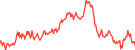
Opal Price Chart (OPAL)
Switch & Compare
| 1h | 24h | 7d | 14d | 30d | 1y |
|---|---|---|---|---|---|
| 0.2% | 0.8% | 7.5% | 5.9% | 1.4% | - |
OPAL Converter
Opal Statistics
| Market Cap | $23.52M |
|---|---|
| Market Cap / FDV | 0.91 |
| Fully Diluted Valuation | $25.872M |
| 24 Hour Trading Vol | $3,881.00 |
| Circulating Supply | 199.998M |
| Total Supply | 219.998M |
| Max Supply | 1B |
 Sponsored
Sponsored
Sponsored
Sponsored
Sponsored

OPAL Historical Price
| 24h Range | $0.1167 – $0.1197 |
|---|---|
| 7d Range | $0.1063 – $0.1200 |
| All-Time High |
$0.2891 59.3%
|
| All-Time Low |
$0.03802 209.3%
|
How do you feel about OPAL today?

About Opal (OPAL)
Opal is a privacy-first perpetual decentralized exchange (DEX) built on Ethereum that focuses on the trading of tokenized real-world assets (RWAs).
- The platform utilizes hardware-isolated Trusted Execution Environments (TEEs) to protect trader intent by sealing orders until settlement.
- It aims to eliminate unfair advantages such as front-running and predatory bots by keeping trade details hidden from both the public and the exchange house.
- The protocol implements a revenue-sharing model where 100% of protocol service fees are distributed to OPAL holders in the form of ETH.
What Is Opal?
Opal is a decentralized derivatives platform designed to bring institutional-grade privacy and fairness to on-chain trading. Its primary value proposition is the protection of user strategies through "sealed order" execution, ensuring that trades are not visible in the public mempool where they could be exploited by arbitrageurs or MEV (Maximal Extractable Value) bots.
Value moves through the system via trading activity on its perpetual markets. Users interact with the exchange in a non-custodial manner, meaning they retain full ownership of their private keys and funds at all times. The OPAL token is put to work as a reward-bearing asset; by holding the token, users are eligible to receive a portion of the platform's revenue. This mechanism scales as the ecosystem grows, as increased trading volume leads to higher protocol service fees, which are subsequently pooled and distributed to the token holder community.
What Makes Opal Unique?
- House-Blind Design: Unlike traditional exchanges that can see user orders, Opal's matching engine operates inside a TEE, making the exchange itself unable to view user strategies until settlement.
- MEV Protection: By encrypting orders client-side and committing them to auctions before they reach the public network, the protocol effectively neutralizes front-running and other forms of MEV.
- Tokenized RWA Focus: The exchange is specifically optimized for real-world assets, providing a venue for the private trading of tokenized physical and tangible assets.
- Full Revenue Distribution: Opal stands out by committing 100% of its generated protocol service fees to its token holders, rather than retaining a portion for the development team or treasury.
What Can You Use Opal for?
- Private Perpetual Trading: Users can open and manage leveraged positions on various assets without exposing their trade intent to the public.
- Yield Generation: Holders can use the OPAL token to earn passive income in ETH through the protocol's weekly fee distribution system.
- Institutional Trading: The platform provides API and integration support for institutional funds requiring high levels of execution privacy and verifiability.
- On-chain Verification: Every trade fill emits a proof of fairness that can be verified on-chain by any participant without revealing the underlying trade strategy.
How Does Opal Work?
Opal operates through a four-step technical process designed to maintain privacy and transparency. First, a user's order is encrypted on the client side (Seal), ensuring that no sensitive data reaches the public mempool. Second, these sealed orders are queued in micro-auctions and settled inside a Trusted Execution Environment (Execute). This hardware-isolated environment matches trades at a single uniform price within sub-second windows, preventing priority-fee manipulation.
Third, the matching engine generates an on-chain proof of fairness for every fill (Prove), allowing anyone to verify that the execution was handled correctly according to protocol rules. Finally, the protocol collects protocol service fees from these trades and deposits them into a distribution contract (Reward). This contract automatically pays out the accumulated ETH to OPAL holders on a weekly basis, completing the economic cycle of the DEX.
Team Info and Investors
Opal was developed by a team led by the former DeFi Trading engineering lead from Coinbase. The project emphasizes a non-custodial and transparent governance approach, although specific details regarding a formal DAO structure or a list of early-stage venture investors are not specified in the available source material.
Where can you buy Opal?
OPAL tokens can be traded on decentralized exchanges. The most popular exchange to buy and trade Opal is Uniswap V2 (Base), where the most active trading pair OPAL/WETH has a trading volume of $3,891.91 in the last 24 hours.
What is the daily trading volume of Opal (OPAL)?
The trading volume of Opal (OPAL) is $3,881.00 in the last 24 hours, representing a -55.90% decrease from one day ago and signalling a recent fall in market activity. Check out CoinGecko’s list of highest volume cryptocurrencies.
What is the highest and lowest price for Opal (OPAL)?
Opal (OPAL) reached an all-time high of $0.2891 and an all-time low of $0.03802. It’s now trading -59.30% below that peak and 209.30% above its lowest price.
What is the market cap of Opal (OPAL)?
Market capitalization of Opal (OPAL) is $23,520,257 and is ranked #831 on CoinGecko today. Market cap is measured by multiplying token price with the circulating supply of OPAL tokens (200 Million tokens are tradable on the market today).
What is the fully diluted valuation of Opal (OPAL)?
The fully diluted valuation (FDV) of Opal (OPAL) is $25,872,306. This is a statistical representation of the maximum market cap, assuming the maximum number of 1 Billion OPAL tokens are in circulation today. Depending on how the emission schedule of OPAL tokens are designed, it might take multiple years before FDV is realized.
How does the price performance of Opal compare against its peers?
With a price increase of 7.50% in the last 7 days, Opal (OPAL) is outperforming the global cryptocurrency market which is up 4.00%, while outperforming when compared to similar Ethereum Ecosystem cryptocurrencies which are up 0.00%.
How to add Opal (OPAL) to MetaMask?
Adding Opal (OPAL) to MetaMask allows you to view your token holdings, trade on decentralized exchanges, and more. To add them, you’ll need to import OPAL as a token. You can copy OPAL’s contract address (0x199e2cfaf8b4f2cc5423971ef3749d1c89cf815c) and import it manually, or if you've installed MetaMask's chrome extension, add OPAL to MetaMask with one click on CoinGecko.
Add OPAL to MetaMask.
Opal Markets
| # | Exchange | Pair | Price | Spread | +2% Depth | -2% Depth | 24h Volume | Volume % | Last Updated | |
|---|---|---|---|---|---|---|---|---|---|---|
| 1 |
DEX
|

|
$0.1200 | 0.60% | $56,434.17 | $56,264.61 | $3,881.02 | 100.0% |
Recently
|
|

You may be interested in these latest crypto news


You may be interested in these crypto articles


Global Opal Prices
Related Coins You May Like















 GeckoAI



 Or check it out in the app stores


