







Maker
MKR Price



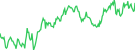
Maker Rallies 7.6% Amidst Lack of Specific News Catalysts
Maker Price Chart (MKR)
Switch & Compare
| 1h | 24h | 7d | 14d | 30d | 1y |
|---|---|---|---|---|---|
| 0.5% | 7.9% | 23.5% | 40.5% | 38.7% | 33.2% |
MKR Converter
Maker Statistics
| Market Cap | $0.00 |
|---|---|
| Market Cap / FDV | 0 |
| Market Cap / TVL Ratio | 0.0 |
| Fully Diluted Valuation | $183.411M |
| Fully Diluted Valuation / TVL Ratio | 0.03 |
| 24 Hour Trading Vol | $393,041 |
| Total Value Locked (TVL) | $6.093B |
| Circulating Supply | - |
| Total Supply | 84,100 |
| Max Supply | 1.006M |
 Sponsored
Sponsored
Sponsored
Sponsored
Sponsored




MKR Historical Price
| 24h Range | $2,009.72 – $2,221.10 |
|---|---|
| 7d Range | $1,722.70 – $2,221.10 |
| All-Time High |
$6,292.31 65.4%
|
| All-Time Low |
$168.36 1194.4%
|
How do you feel about MKR today?

What is the Maker token (MKR)?
The Maker token (MRK) is a governance token that is used to govern and recapitalize the Maker protocol. Holders of the token can participate and vote on changes to the protocol’s smart contract and system parameters such as Stability Fees and the Dai Savings Rate (DSR).
What is Maker?
Maker is a smart contract lending platform that enables users to take out loans by locking-in collateral in exchange for Dai. It was founded by the Maker Foundation in 2015 as an open-source project to offer economic freedom and opportunities to anyone, anywhere. In 2017, it launched the Maker governance token (MKR) and its first stablecoin iteration known as the Single Collateral Dai (SAI), which used Ether (ETH) as collateral.
Two years later in 2019, the Foundation released the Multi-Collateral Dai (DAI), phasing out SAI. The platform has enjoyed widespread adoption and is the largest decentralized lending platform with around $2.58 billion in total value locked (TVL), as of December 2020.
What can the Maker token (MKR) do?

The Maker token has two core functions: i) governance and ii) recapitalization. In terms of governance, MKR token holders are responsible for monitoring, participating, and voting on proposals or changes to ensure the overall health of the Maker protocol. This is done via two types of polls which are executed through smart contracts: i) proposal polling and ii) executive polling.
The former is used to gauge the consensus of the Maker community towards a proposed change. It is a preliminary step, conducted to ensure that proposals are well thought out before formal voting begins in executive polling. In that stage, MKR holders officially vote to approve or disapprove a proposal. The smart contract address which receives the highest number of MKR tokens is then elected as the active proposal. Further details on polls can be found in Maker’s whitepaper.
Some examples of changes that have been proposed or implemented in the protocol are: adding a new collateral asset, modifying the Dai Savings Rate (DSR), choosing a set of oracle feeds and upgrading the Maker contract’s functionality. Users can view all current and previous polls, as well as their outcomes, on Maker’s governance page.
The second function of the MKR token is recapitalization. In the event that system debt exceeds surplus, additional MKR tokens are minted by the protocol and sold for Dai through debt auctions to help bring the ecosystem back from insolvency.
On the other hand, if system surplus exceeds debt, the protocol sells Dai via a surplus auction for MKR, which is subsequently burned. This mechanism incentivizes MKR holders to keep the system running as intended; bad governance will result in MKR value dilution and vice versa. More information on recapitalization can be found in Maker DAO’s community development page, while auctions are elaborated on here.
How does Maker work?

The Maker protocol functions similarly to a bank. It provides loans and charges interest on borrowings and savings denominated in its native stablecoin, Dai.
In traditional finance, these services are only ever provided after fulfilling several stringent requirements such as the provision of sufficient collateral, robust credit scores and compliance with KYC and criminal background checks. With Maker however, users need only provide collateral in the form of cryptocurrencies. No KYC is needed, and loans are issued in a decentralized manner via smart contracts.
In practice, a Dai loan is obtained by heading over to Oasis and locking-in collateral in smart contracts known as Maker Vaults. The loan amount would depend on two factors: i) the amount of collateral locked-in and ii) the chosen collateral’s collateralization ratio.
For instance, if a user chooses Ether (ETH) as collateral and the collateralization ratio of ETH is 150%, then the user would need to lock-in 1.5 ETH for every 1 Dai he/she mints. And similar to a regular loan, a Dai loan will incur debt and accrue an interest fee known as the Stability Fee. However, it can also generate savings through the Dai Savings Rate mechanism (DSR).
The Maker token thus keeps the Maker ecosystem functioning smoothly by determining what cryptocurrencies are suitable to be used as collateral, the collateralization ratio required for these assets, their associated Stability Fees, and the DSR. In effect, it serves to regulate Dai’s soft-peg to the US dollar and keep Vaults overcollateralized.
Further explanation on the inner workings of Stability Fees, DSR and Dai can be read in the protocol’s whitepaper.
Where can you buy Maker?
MKR tokens can be traded on decentralized exchanges. The most popular exchange to buy and trade Maker is Uniswap V4 (Ethereum), where the most active trading pair SKY/MKR has a trading volume of $238,896.58 in the last 24 hours. Other popular options include Uniswap V2 (Ethereum) and Uniswap V3 (Ethereum).
What is the daily trading volume of Maker (MKR)?
The trading volume of Maker (MKR) is $392,607.86 in the last 24 hours, representing a -43.90% decrease from one day ago and signalling a recent fall in market activity. Check out CoinGecko’s list of highest volume cryptocurrencies.
What is the highest and lowest price for Maker (MKR)?
Maker (MKR) reached an all-time high of $6,292.31 and an all-time low of $168.36. It’s now trading -65.40% below that peak and 1,194.40% above its lowest price.
What is the fully diluted valuation of Maker (MKR)?
The fully diluted valuation (FDV) of Maker (MKR) is $183,274,382. This is a statistical representation of the maximum market cap, assuming the maximum number of 1 Million MKR tokens are in circulation today. Depending on how the emission schedule of MKR tokens are designed, it might take multiple years before FDV is realized.
How does the price performance of Maker compare against its peers?
With a price increase of 23.50% in the last 7 days, Maker (MKR) is outperforming the global cryptocurrency market which is down -0.50%, while outperforming when compared to similar Made in USA cryptocurrencies which are down -3.50%.
How to add Maker (MKR) to MetaMask?
Adding Maker (MKR) to MetaMask allows you to view your token holdings, trade on decentralized exchanges, and more. To add them, you’ll need to import MKR as a token. You can copy MKR’s contract address (0x9f8f72aa9304c8b593d555f12ef6589cc3a579a2) and import it manually, or if you've installed MetaMask's chrome extension, add MKR to MetaMask with one click on CoinGecko.
Add MKR to MetaMask.
Maker (MKR) Security Ratings


Maker (MKR) Token Holders
Maker Markets
| # | Exchange | Pair | Price | Spread | +2% Depth | -2% Depth | 24h Volume | Volume % | Last Updated | |
|---|---|---|---|---|---|---|---|---|---|---|
| 1 |
DEX
|

|
$2,179.19 | 0.60% | $5,985.59 | $5,967.60 | $186,236 | 46.72% |
Recently
|
|
| 2 |
DEX
|
|
$2,179.19 | 0.60% | $34,023.67 | $33,921.44 | $72,195.80 | 18.11% |
Recently
|
|
| 3 |
DEX
|
|
$2,179.19 | 0.60% | $8,649.71 | $8,623.72 | $71,247.11 | 17.87% |
Recently
|
|
| 4 |
DEX
|
|
$2,179.19 | 0.60% | $9,190.59 | $9,162.98 | $57,799.68 | 14.5% |
Recently
|
|
| 5 |
DEX
|
|
$2,181.43 | 0.63% | $310.17 | $309.24 | $1,766.10 | 0.44% |
Recently
|
|
| 6 |
DEX
|
|
$2,179.19 | 0.61% | $690.11 | $688.04 | $1,092.36 | 0.27% |
Recently
|
|
| 7 |
DEX
|
$2,191.98 | 0.62% | $216.56 | $248.29 | $416.09 | 0.1% |
Recently
|
||
| 8 |
DEX
|
|
$2,179.19 | 0.62% | $276.46 | $275.63 | $281.33 | 0.07% |
Recently
|
|
| 9 |
DEX
|
|
$2,189.76 | 0.64% | $235.04 | $234.33 | $222.39 | 0.06% |
Recently
|
|
| 10 |
DEX
|
|
$2,179.19 | 0.65% | $186.82 | $186.26 | $307.13 | 0.08% |
Recently
|
|


Maker Latest News


Maker Guides



Global Maker Prices
Related Coins You May Like














 GeckoAI



 Or check it out in the app stores


